Snapshots of a first visit in Paris, with Melinda
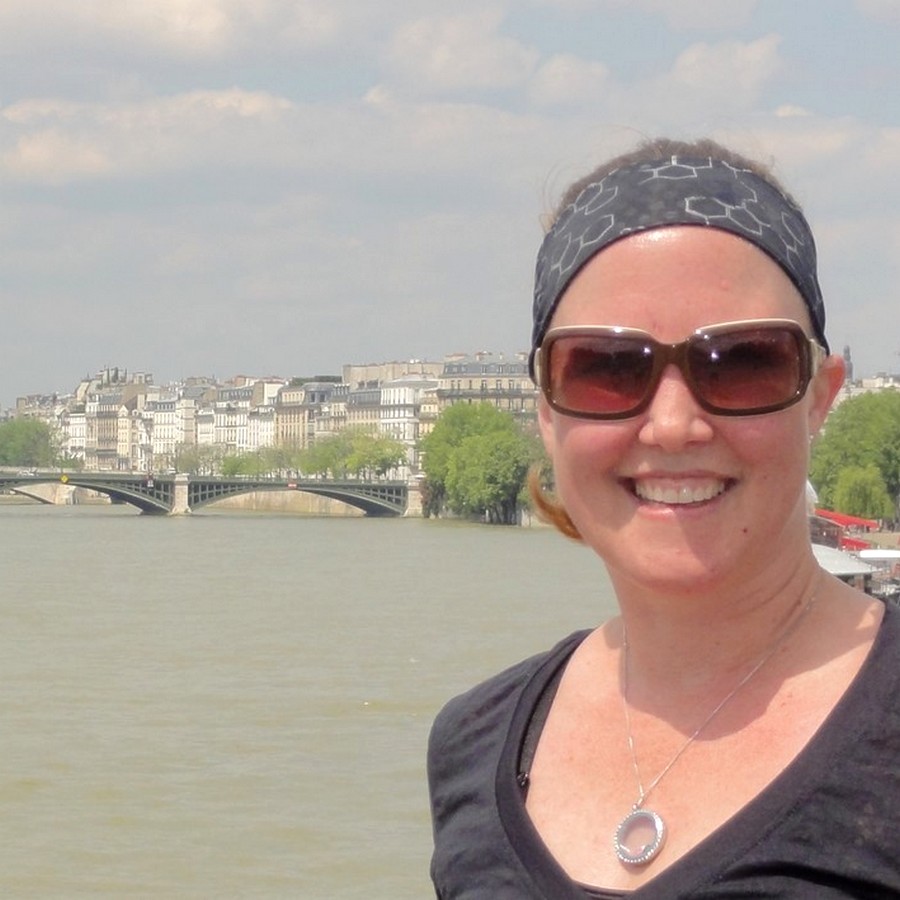
Melinda – On the bridge of Austerlitz. In the distance, Notre-Dame and Saint Louis Island beautiful houses Monday 27th May – 12:51 PM, Wednesday 29th May – 6:57 PM – First time in Paris for Melinda from Miami (USA) ! What better choice than to start a first stay in Paris doing a visit by running (with Paris Running Tour)? A good way of unwinding legs after a long travel by plane and a first discovery of Paris getting directly into the life of the city. And why not begin again two days later to discover new paths through Paris? We thus ran by following two routes which mainly crossed the disctrict of “Le Marais”, the Left bank, the island of “La Cité” and the center of Paris around the Seine. Here is the route (numbers indicate where the photos of this article were taken): We took numerous photos during our running: 1) “La rue des Barres” (Street of Bars). This name comes because formerly, in the 10th century, on the location of the street, a wall, a fence of wooden bars, constituted a wall protecting Paris: Melinda – “Rue des Barres” 2) “L’Hôtel de Sully” (The Hotel of Sully). The Duke of Sully, Minister of Finance of king Henri IV, lived in this noble mansion at the end of his life. By crossing the Hotel of Sully, we passed directly from the street Saint Antoine to the “place des Vosges”. Melinda – “Hôtel de Sully” 3) The “bassin de l’Arsenal”. Having crossed the place of the Bastille, we met the Basin of the Arsenal, port and canal connecting the river Seine with the Saint Martin canal and which, formerly, was a ditch which filled the moats of the castle of the Bastille. Melinda – “Port de l’Arsenal” 4) “Pont d’Austerlitz” (Bridge of Austerlitz). See the picture at the beginning of the article. 5) “Cour du Commerce Saint André”. Another place which is situated on the plan of the former surrounding wall of Paris, the wall of king Philippe Auguste. This passage, opened in 1776, allows to reach the Café Procope (1686), one of the oldest cafés in the world. Melinda – “Cour du Commerce Saint André” Second tour : 6) “Le Tribunal de Commerce de Paris” (Commercial court). This building presents the peculiarity to have a dome placed not in the center, but on the side, in a way that the dome is visible from the Boulevard Sevastopol. The dome closes the perspective of the Boulevard by the South. Melinda – On the bridge Notre Dame. We can see, on the island of “La Cité”, successively, the Hôtel-Dieu (Hospital), the “Tribunal du Commerce de Paris” and the Conciergerie. 7) On the “Pont Neuf” (“New” Bridge). Melinda – Pont Neuf. On left, the “Institut de France”, the Eiffel tower and, on right,the “Musée d’Orsay” 8) Colonnade of the Louvre. Summit of the French classicism, the Colonnade of the Louvre was realized at the request of king Louis XIV. The Colonnade of the Louvre served as model to numerous famous buildings, in particular, the Capitol of the United States in Washington, Metropolitan Museum of art in New York and San Francisco War Memorial Opera House. Melinda – The “Colonnade du Louvre” 9) Alexandre III bridge. The widest bridge in Paris. Built with the “Grand” and “Petit Palais” for the World Fair of 1900. The bridge offers a direct link between the “Invalides” and the Champs-Elysées. Melinda – the Alexandre III bridge – In the distance, the “Invalides” 10) The Champs Elysées. Melinda – Champs Elysées, at the end, the “Arc de Triomphe” and far off, the “Grande Arche” of “la Défense” 11) The equestrian statue of Joan of Arc, place of the Pyramids. She is situated not far from the Gate Saint Honoré, where Joan of Arc tried to cross Charles V’s surrounding wall to reconquer Paris, occupied at the time by the English. She was hurt by an arrow in the thigh there. Melinda – Equestrian statue of Joan of Arc, of Frémiet and inaugurated in 1874 12) The Puget courtyard in the Louvre. Melinda – Puget Courtyard, situated with the Marly Courtyard on both sides of the passage which connects the Louvre Pyramid to the street of Rivoli 13) Stravinsky fountain. This fountain, fountain Stravinsky or fountain of automatons, was created by the couple of artist Nikki de Saint Phalle and Jean Tinguely in 1983 and evokes the work of the composer Stravinsky. Melinda – the “Fontaine Stravinsky”, on the right George Pompidou Center Interesting and beautiful discoveries, isn’t it? Merci Melinda ! The route of the tours:
Running under the bridge Saint-Michel with Antje
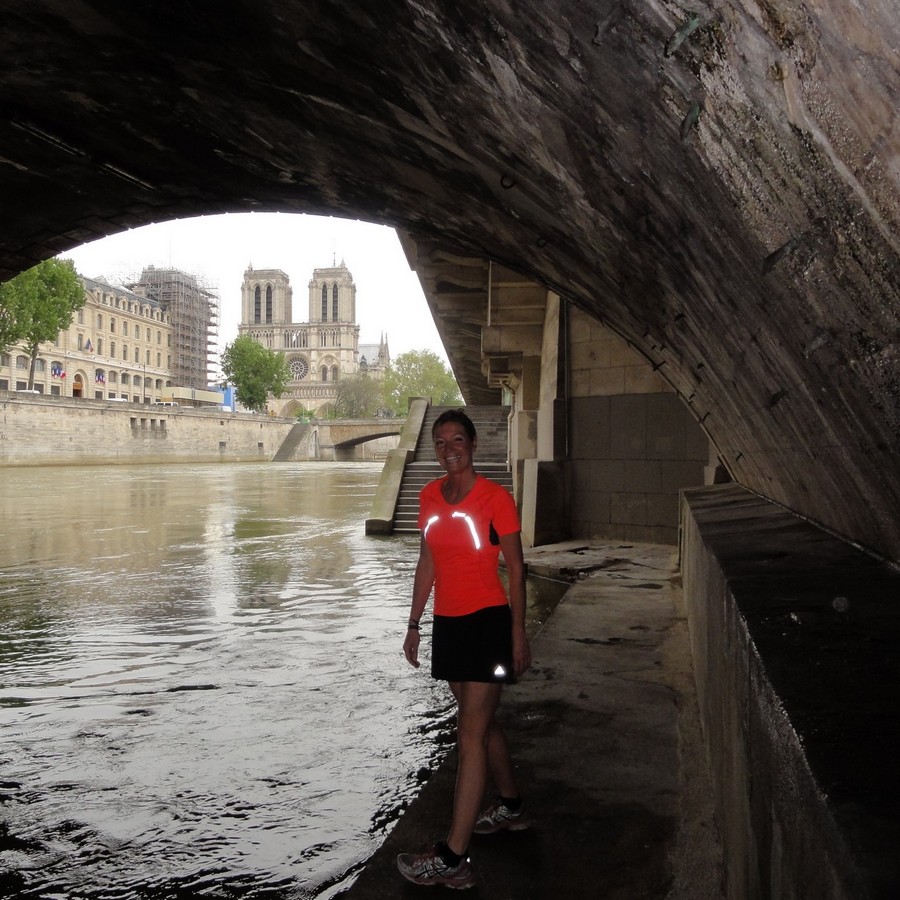
Antje – Under Saint-Michel bridge – In the background, “Notre-Dame de Paris” 7h57 – Antje comes from another great and beautiful European capital, Berlin. She already ran several times the Berlin marathon, one of the fastest world marathons (the last four world records were realized in Berlin). Antje knows well Paris and that is with pleasure and while running that we rediscovered its most beautiful “paths”. A beautiful route of more than 14 km also passing under bridges of Paris as we can see on the photo above. Our running led us of the Eiffel Tower up to Notre-Dame, then up to the Arc of Triumph. This Friday was making the “bridge” between two holidays, May 8th&9th and the weekend so Paris was very quiet, even the Eiffel Tower seemed deserted (at least at 8 am in the morning). Antje – “Champs de Mars” and Eiffel tower Notice the scaffolds which leave the ground towards the first floor of the Eiffel Tower. These temporary elements are of use to the renovation of the first floor. The objective of this modernization project is to make this floor a more attractive place => Click here. Back from Notre-Dame, this time, it is ON the “Pont Neuf”, the New Bridge, that we ran: Antje – “Pont Neuf” – In the background, the “Pont des Arts” (bridge of the Arts) As its name does not indicate it, the “Pont Neuf”, literally “New Bridge”, is the oldest bridge of Paris. As you can read it on the photo, the bridge was built at the end of the 16th century. Yes, “neuf” means “new” (and not “9”). Is the oldest bridge the new bridge? Indeed, at the time of its construction, this bridge was very modern: all in stone, without houses on its edges (at last, we could know that we were really on a bridge while crossing it, impossible with houses!), and with sidewalks! These sidewalks were really new because very rare in Paris at that time… The “Pont Neuf”, already at that time, a beautiful place to stroll, to appreciate the sight and Paris! Farther, we pursued our route along the historic axis of Paris (see here), the Louvre, the Louvre Pyramid and the garden of the Tuileries : Antje – “Cour carrée du Louvre” Antje – Small break near the Louvre Pyramid Antje – In the garden of the Tuileries We then continued our road along the Champs-Elysées to go uphill towards the Arc of Triumph. Uphill? Yes indeed, do you know that the Arc of Triumph is put on what we called formerly the “colline du Roule” (The hill of the Roule). In 1768, this hill was leveled to have a more regular slope towards the Gate of Neuilly. The top of the hill was then 5 meters higher. Paris as flat as Berlin? Hem, not completely… So remember, when you will take the departure of the Paris marathon and will start with the Champs-Elysées, do not run too fast: if it is so easy, it is because you are in descent! Merci Antje ! The route of the tour:
On the “Pont des Arts” with Manoella
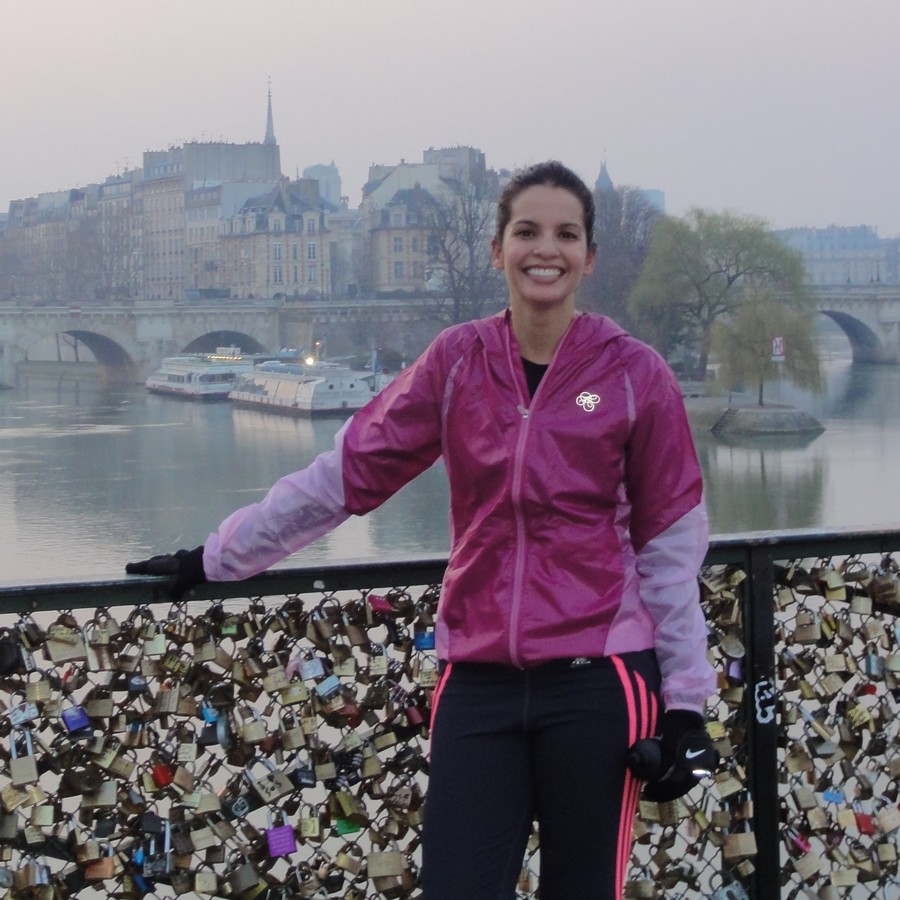
7:06 AM – Manoella, who lives in São Paulo (Brazil), came to stay some time in Paris. She will participate in a major event, the Paris Marathon! It will be her first marathon, we can appreciate this choice, what better than Paris? 😉 No unnecessary risks in 7 days of the marathon (April 7th, 2013 ), we ran quietly and took advantage of a route around the Latin Quarter, on the “Ile de la Cité” and also right bank: Louvre, Palais Royal, Pompidou Center, the “Marais”. Early on Sunday morning, very few people on the route, see how the Louvre is quiet : The winter does not want to go and it is by the temperature of -2°C (28.4°F) that we ran . March 31st! Well, this cold gave a beautiful particular luminosity to the city, we admired Notre-Dame nicely “colored” : Manoella, we wish you a magnificent first marathon in Paris! Merci Manoella ! The route of the tour :
In front of the oldest tree of Paris with Michael
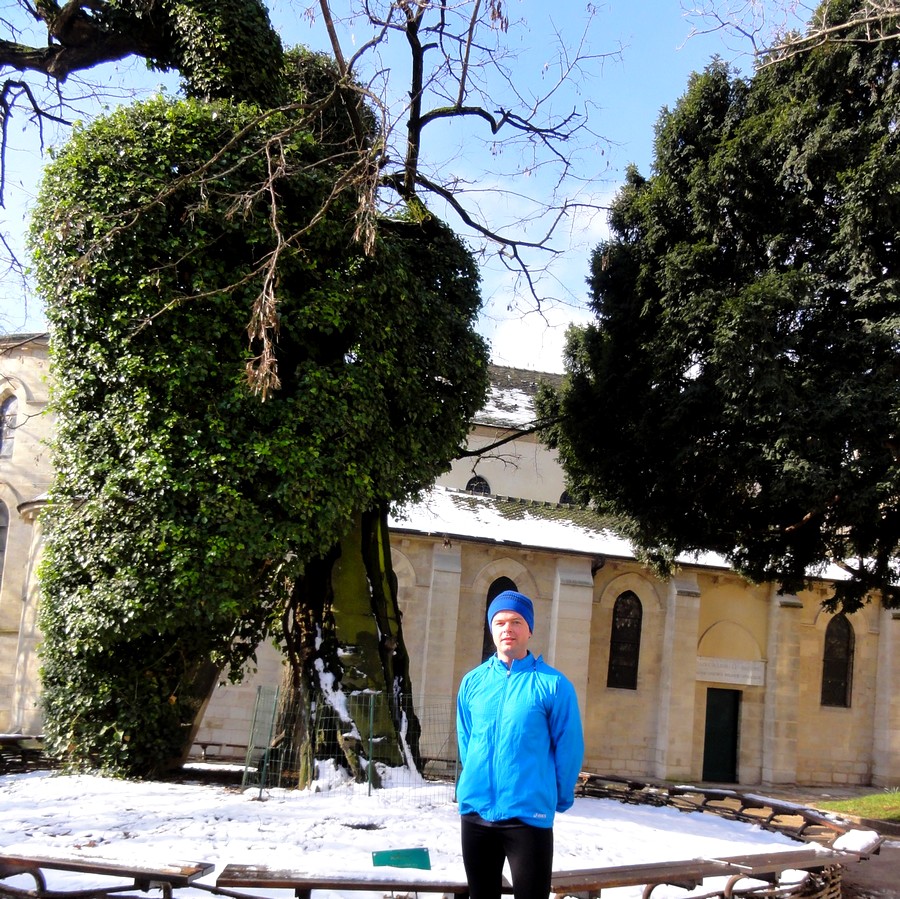
Michael – Garden René Viviani, in the background the church “Saint-Julien le Pauvre” 9:01 AM – Michael, who lives in Hamburg (Germany), began his first visit of the capital by a Paris Running Tour. Having left the district of the “Gare de Lyon”, we traveled the garden of Plants, crossed the Latin Quarter on the left bank, visited the Island of “La Cité”, then of return on the right bank, saw the Pompidou Center and the “Marais” quarter. We discovered in particular the Gallo-Roman Paris by admiring the Arenas of Lutecia, the Roman Thermal baths and the archaeological crypt where we can see real Roman streets. Before leaving the Latin Quarter, in the Public garden René Viviani, we greeted the oldest tree of Paris (we can see it on the photo above). This Black Locust tree (Robinia pseudoacacia) was planted in 1601 by the botanist Jean Robin who introduced it in France (the tree is native of North America). The public garden René Viviani faces the Cathedral Notre-Dame-de-Paris as we can see on the photo below: Michael – “Square René Viviani” and Notre-Dame de Paris A little earlier, it is another place of worship we crossed, the Big Mosque of Paris: The “Grande Mosquée” of Paris The Big Mosque of Paris was inaugurated in 1926. Of Spanish-Moresque style, it possesses a 33 meter minaret. The Mosque is opened to the tourist visits. On the right bank, very close to another “temple”, “temple” of the culture this time, the Georges Pompidou Contemporary Arts Center, we contemplated beautiful mural paintings, of which the stencil “Chuuuttt!!!” of Jef Aérosol: Michael – “Chuuuttt !!!” from Jef Aérosol (2011) In the “Marais”, we took a shortcut which made us, directly from the street Saint Antoine pass on the beautiful “Place des Vosges”: Michael – “Hôtel de Sully” A magnificent shortcut, the Hotel of Sully! This “Hôtel particulier” (mansion) allows to join the “place des Vosges” by way of the inside courtyard and the garden. Built at the beginning of the 17th century, it was the property of the “Duke de Sully”, king Henri IV’s Minister of Finance. It shelters now the Center of the National Monuments. Merci Michael ! The route of the tour :
Paris Competitions News: Paris Half-Marathon!
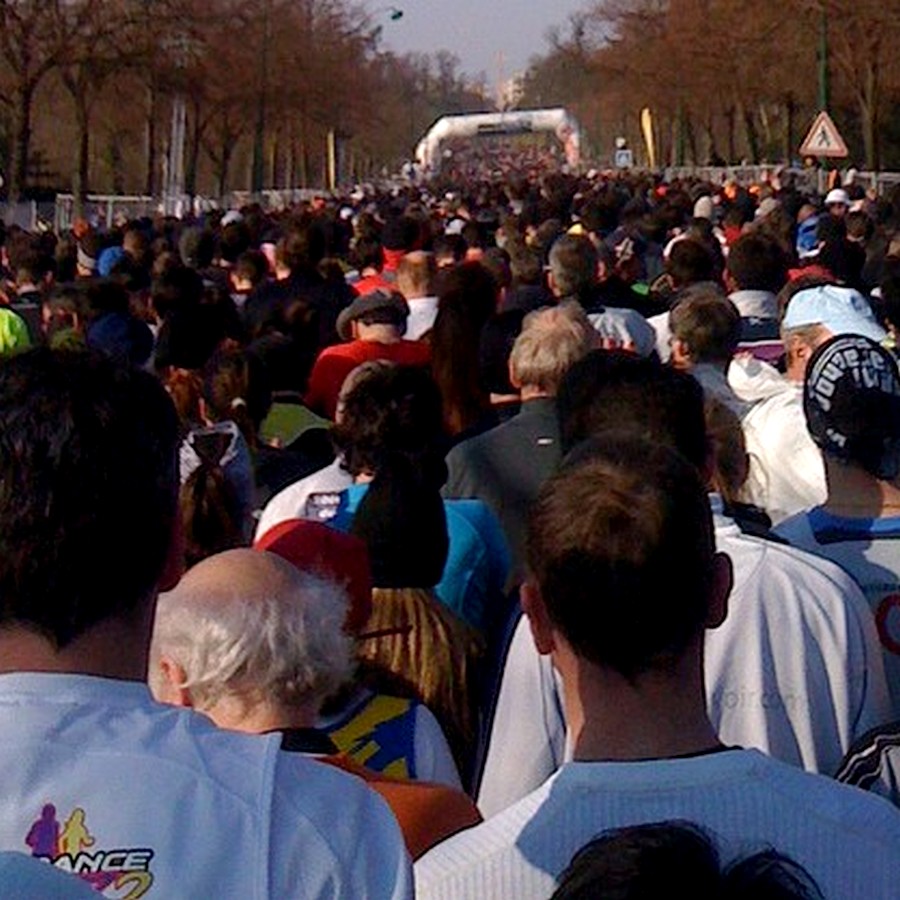
Paris Half-Marathon 2010 – Into the starting areas looking forward to the start… On Sunday, March 3rd, 2013, it is the half marathon of Paris, a little more than 21 km (>13mi) for a race in the East of Paris. 40000 runners for this new edition! A beautiful sports route and a good preparation for the next marathon of Paris which will take place on Sunday, April 7th. A sports route but also a beautiful touristic stroll, so, of course, you will see at first and on arrival the magnificent castle of Vincennes, but even if you are in full effort, take advantage of the stroll, raise eyes and look at Paris around you… Maybe it will make your running easier? So don’t miss, for example: Notre-Dame On your road between the 12th and the 13th kilometer, Notre-Dame at your left on the “Ile de la Cité” L’Hôtel de Ville At the 13th kilometer, before turning left, have a look to the “Mairie de Paris”, the City hall of Paris The tracks of the Castle of “La Bastille” Just before the place of the Bastille, between the 14th and the 15th kilometer, on the ground, tracks indicating the locations of towers and walls of the former Bastille castle (if the crowd allows you to see them) You will see many other magnificent and historic places all along the route, take advantage of it (and if you have other remarkable places that you want to share with us, say it in a comment, thanks!). Enjoy your race!
Running in October in Paris
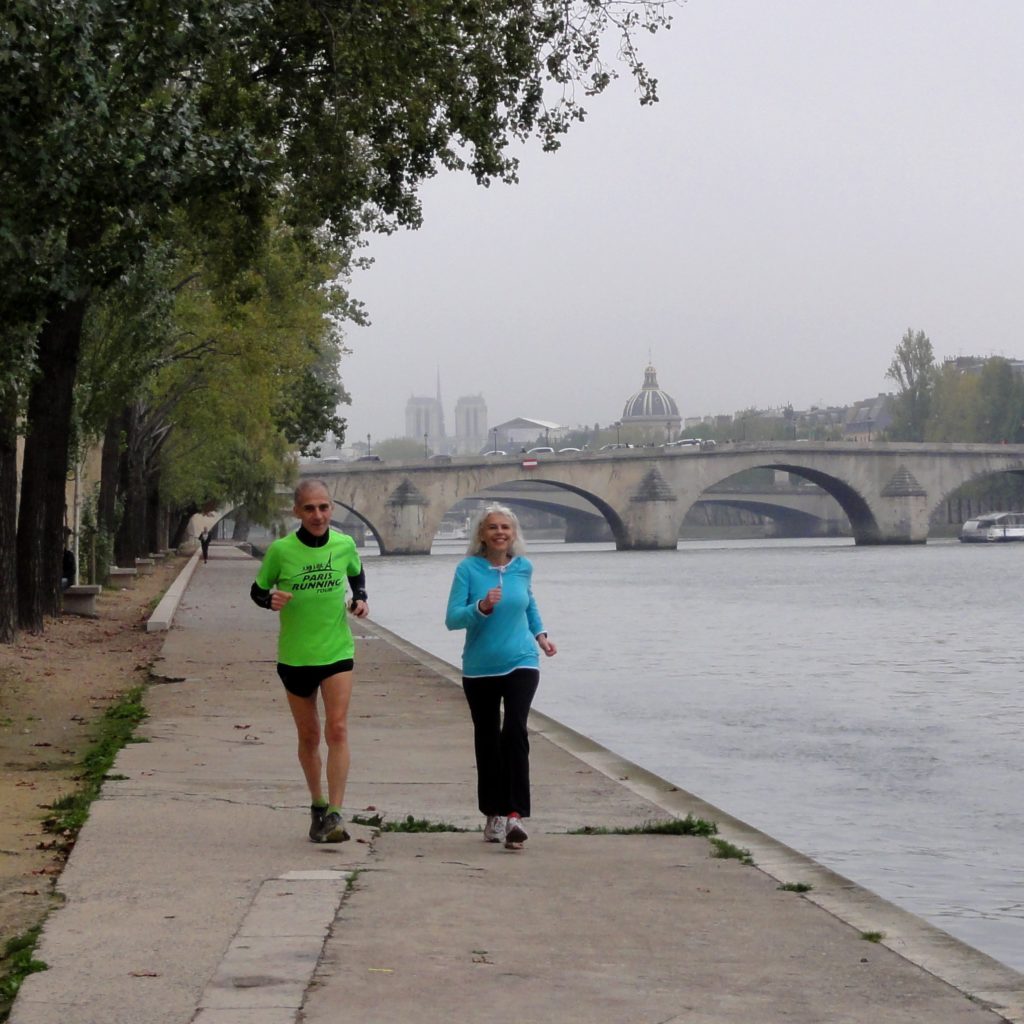
Right bank – Far off the Pont Royal (Royal Bridge), Notre-Dame and the dome of the Institute of France Garden of the Tuileries – Far off, the Louvre The bridge of “la Concorde” then the place of “la Concorde” and its obelisk, with, far off, on the left, the “Hôtel de Crillon”, the “Hôtel de la Marine” on the right and in the center, “La Madeleine” The “esplanade des Invalides” – The “Hôtel des Invalides” No matter what month we are, it is always a pleasure to run in Paris! Come and do a tour, a nice visit while running with Paris Running Tour!
A long sunny tour with Colin
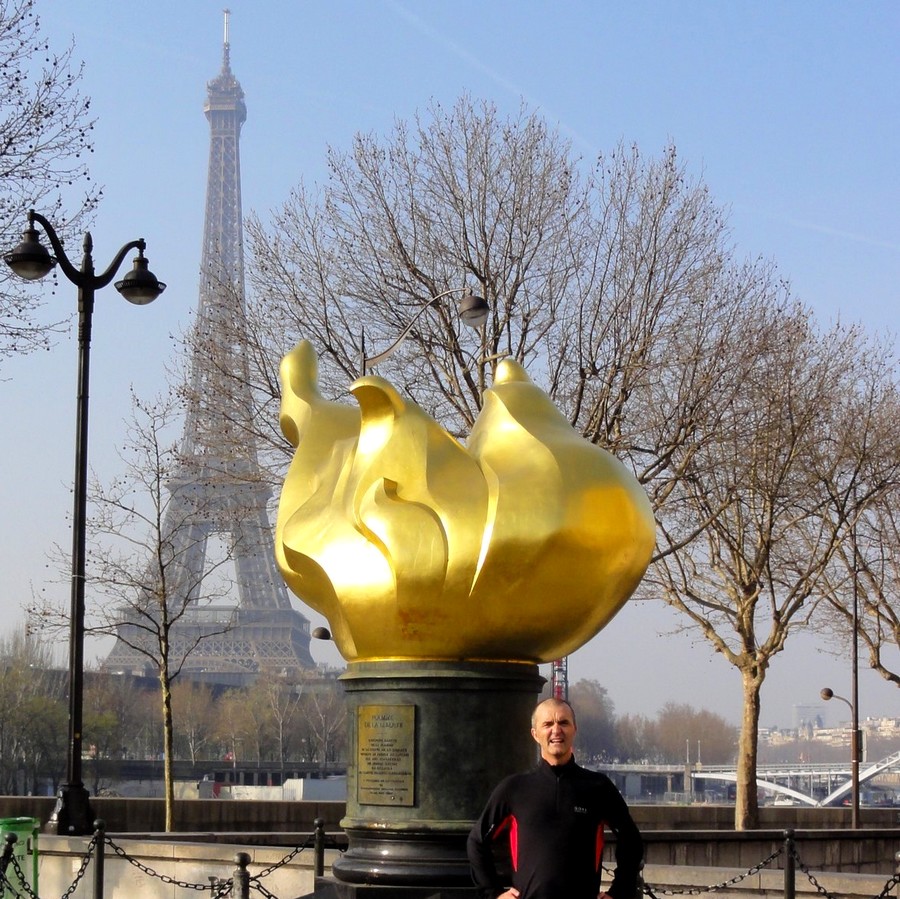
Colin – Place de l’Alma 8:00 AM – With Colin, we had decided to run a long tour along the Seine. A beautiful morning, the sun was with us. Colin comes from Australia but works in India. Long distances enthusiast, Colin intends to run his first marathon in Bombay, a rather difficult marathon because of the heat and of the humidity We thus left by following the Seine on the left bank, by greeting for the first time the Eiffel Tower. We then crossed the river by the “Ile de La Cité”, admired Notre-Dame and joined the right bank to make a small break in the Louvre. Colin – Rue de l’Université, Notre Dame, Le Louvre Having crossed the garden of the Tuileries, arrived in front of the Obelisk of the place de la Concorde, we evoked the time of the Pharaoh Ramses II. With such a light, we owed have small breaks to photograph the Eiffel Tower, and it is by the bridge of Bir-Hakeim that we returned on the left bank. Colin – Obelisk of “la Concorde”, Trocadéro, Bridge of Bir-Hakeim But, what is this flame place of the Alma, which we can see on the photo at the top of the article? The plate indicates: “ The Flame of Liberty. An exact replica of the Statue of Liberty’s flame offered to the people of France by donors throughout the world as a symbol of the Franco-American friendship. On the occasion of the centennial of the International Herald Tribune. Paris 1887-1987. “ In 1989, the United States offered this flame to France, to thank the French companies which realized the restoration of the Statue of Liberty on the occasion of its centenary. As its replica, the Flame in New York, lit at the origin from the inside, is now gilded and lit from the outside. Numerous visitors think that this flame was built in homage to Lady Diana, died during her accident in the tunnel of the Alma, situated under the monument. The flame can effectively remind the song of Elton John written in homage to the princess: “Candle in the wind”. Even if Lady Diana is officially commemorated in a small garden in “Le Marais”, we can often see around the Flame of the Freedom, numerous bouquets, photos or messages. The tunnel of the Alma is also the passage of the Paris Marathon (soon, April 15th!). In this place, the race gets closer to the 29th km (18 miles)! Good race to all the runners who will run the Marathon of Paris! Merci Colin ! The route of the tour:
Ancient Paris, modern Paris with Beth, Paige and Pamela
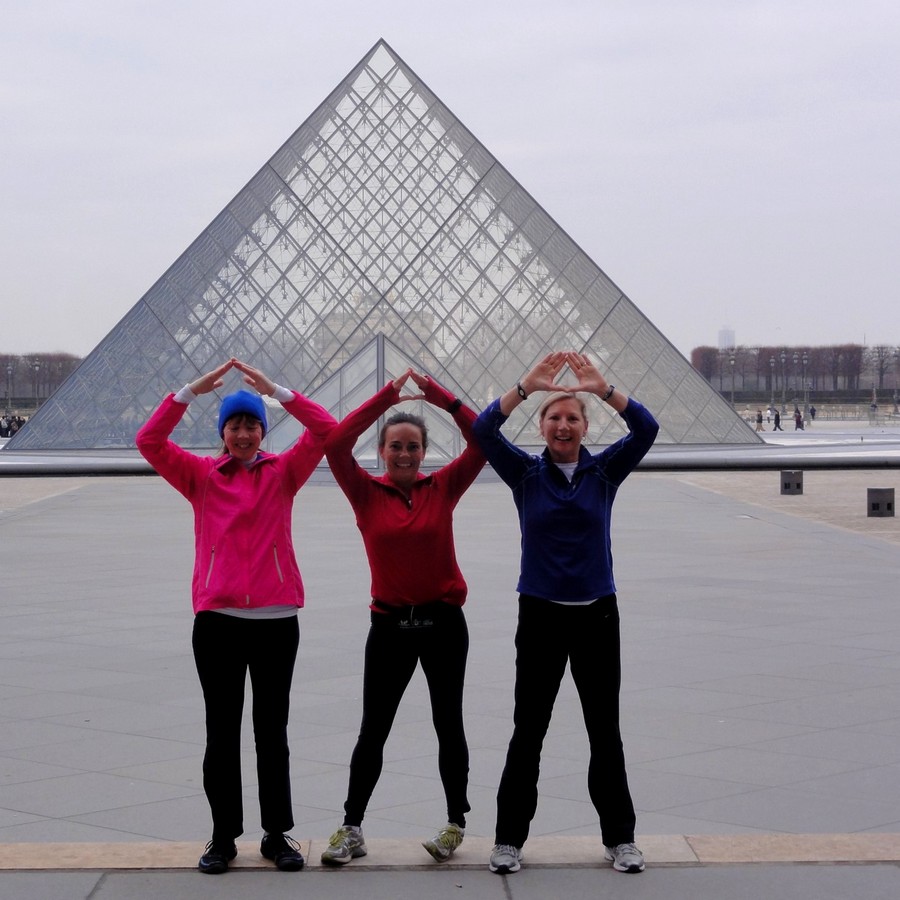
Pamela, Beth, Paige – Bridge of “la Concorde” and “Assemblée Nationale” 8:15 AM – With Beth, Paige and Pamela from North Carolina (USA), we discovered by running the variety of the Parisian landscapes, from the most ancient parts of the city to the most modern Paris: 19th century. We left the “Place de la République” and followed the “boulevard du Temple”, formerly named the “boulevard of the Crime”. This ancient nickname is due to the theaters which populated the boulevard in 19th century, numerous “crimes” were committed but only in the melodramas which occurred there! A place very livened up in the time, remember the beginning of the movie “The children of the paradise” which redraws so well that had to be the Boulevard: 12th century. We then joined “Le Marais” and crossed the most visible part of the surrounding wall of the king Philippe Auguste then admired Notre-Dame. The surrounding wall and the Cathedral which made us return to the end of the 12th century: Wall of Philippe Auguste – Creation 1190 | Cathedral Notre-Dame of Paris – Creation 1163 20th century. After the Middle Ages, it is the end of the 20th century which appeared, at first with the Louvre Pyramid, created by the architect Ieoh Ming Pei in 1989, then with the “Kiosque des Noctambules”, metro entrance (Palais-Royal station) and work of art created in 2000 by the artist Jean-Michel Othoniel: Louvre pyramid – Inauguration 1989 | “Le kiosque des Noctambules” – Installation 2000 Paris always evolves; what will the 21st century give us? Merci Beth, merci Paige, merci Pamela! The route of the tour:
Near a man of the “Enlightment” with Elisa
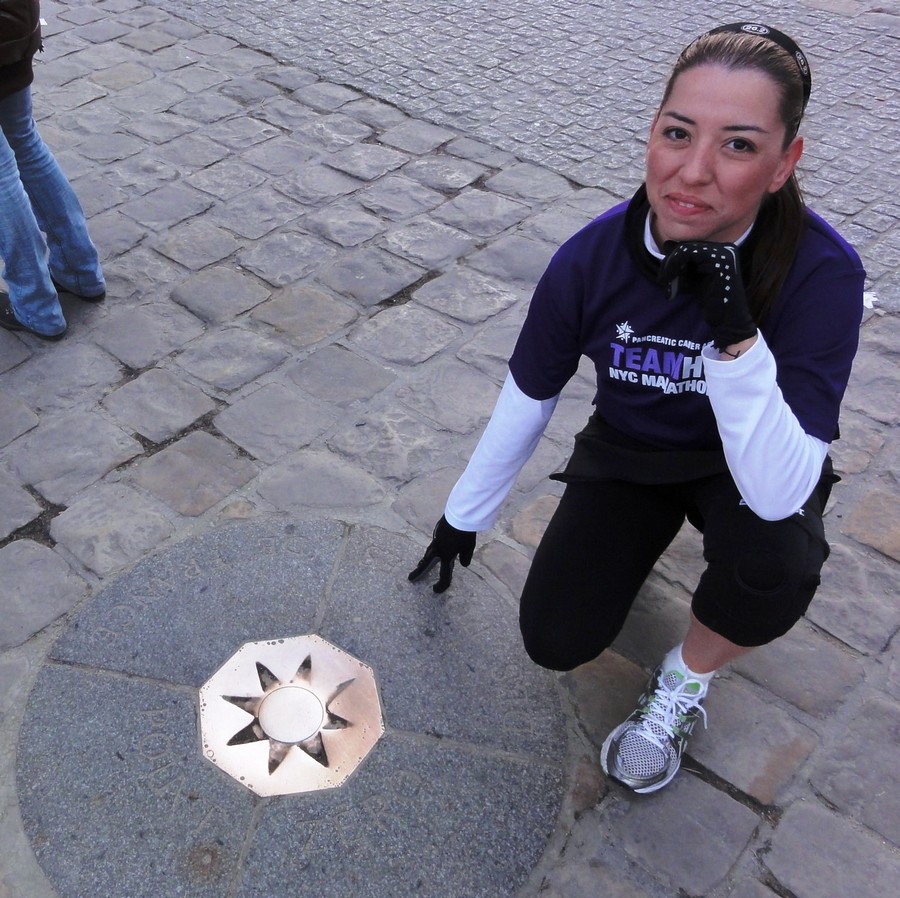
Elisa – Thomas Jefferson – Far off, the “Sacré-Coeur” 9:09 AM – Elisa, from Atlanta (USA), takes back the running having ended the New-York Marathon. On this Sunday of December, we chose a tour along the river Seine. On our road, we crossed Thomas Jefferson, a great friend of France, who liked Paris very much. He was in the same way as his French counterparts, a man of the “Enlightment” and succeeded Benjamin Franklin as Ambassador of United States in France. Thomas Jefferson enjoyed a lot the Architecture. Thomas Jefferson’s statue is, besides, situated just next to a building which he admired very much, the hotel of Salm, otherwise known under the name of the Legion of Honor Palace. This palace was often imitated. You can see, for example, a copy in the Lincoln Park, in San Francisco (USA). If you look closely at the photo with Elisa, quite at the bottom, you will see the “Sacré Coeur”, the very visible church because at the top of Montmartre, in the North of Paris. By running along the river, we may be under the impression to go straight on. By going East by the left bank (for example), at the level of the Bir Hakeim bridge, we can be surprised seeing the “Sacré Coeur” in front of us, while at the another moment, next to Thomas Jefferson for example, we will see it on our left. In Paris, the river Seine is a curve! Join the right bank by the Bir-Hakeim bridge, the “Sacré Coeur” will be on your right. By the footbridge Léopold-Sédar-Senghor, it will be in front of you. At the level of the towers of Notre-Dame, you will see it on your left. In Paris, the Seine is a curve! A little later, we joined the square of Notre-Dame. Have you already noticed on the ground, the point Zero of the roads of France? Elisa next to the point Zero of the roads of France Yes, indeed, Paris is a big city and it is necessary to have a precise point in Paris which serves as reference for the distances with the other cities. What is the distance between Versailles and Paris by road, for example? Not the one who meets a limit of Paris but the one who finishes in the point Zero: Between Versailles (the Castle) and the limit of Paris: approximately 14 km (in red), between Versailles (the Castle) and the zero point: approximately 23 km (in yellow) What about you? Where is the “point zero” of your city? Merci Elisa ! The route of the tour :
By way of the bridge of “l’Archevêché” with Ellen
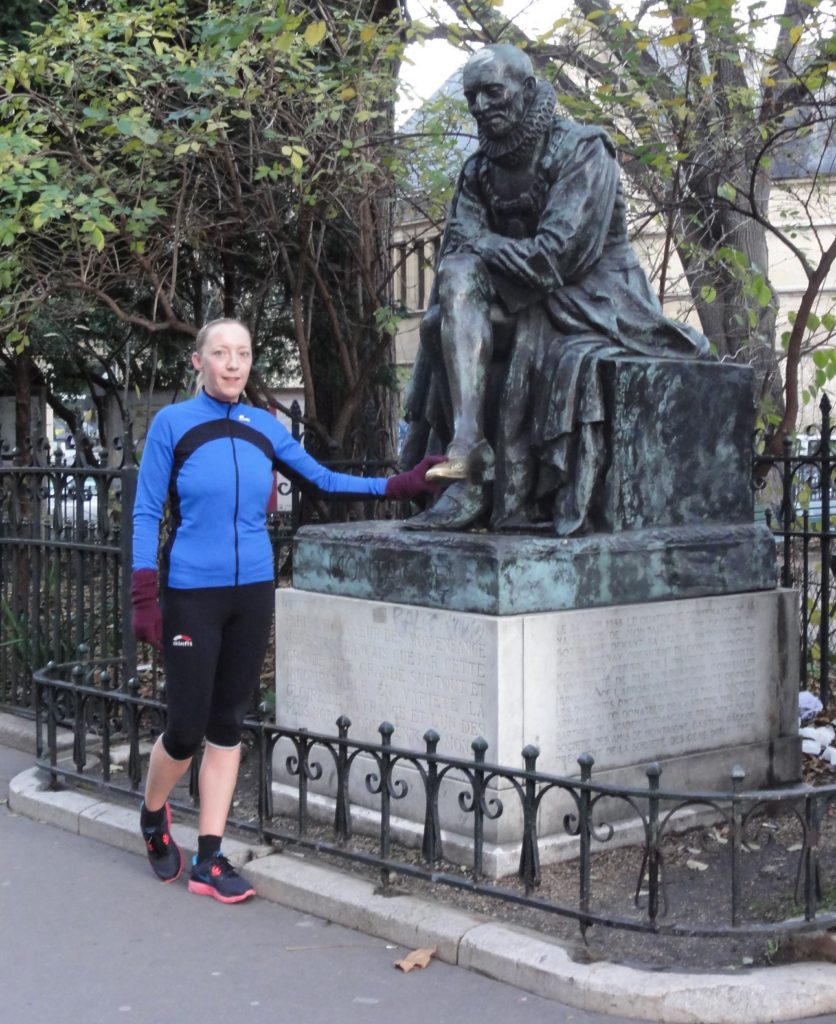
Ellen – Pont de l’Archevêché – Notre Dame 7:58 AM – Ellen, from Antwerp (Belgium), runs regularly very early in the morning. On Saturday, we ran a little later to take advantage of the light which offered us the sun of December. Our road led us on the bridge of “l’Archevêché” which is on the East point of the island of “La Cité”, behind Notre-Dame. As on the Pont des Arts, situated in front of the West point of the island, the padlocks prosper in abundance. Padlocks? Yes, indeed! Padlocks of love! As formerly on trees, the lovers register their both names on a padlock, hang on it to one of the most beautiful places of Paris and throw the key in the river Seine… This fashion would have begun in the 80s in Eastern Europe and appeared on the “Pont des Arts” in 2008 (see the photos of the “Pont des Arts” in this blog). Sometimes, all the padlocks disappear at one go without that we know why, the services of the city of Paris being not at all responsible for these disappearances. Thieves of metals? Padlocks quickly return however. Even the “bouquinistes” (secondhand booksellers along the Seine) adapted themselves and sell, besides the usual books, padlocks! A little earlier on our route, Montaigne: Rue des Ecoles – Montaigne In front of the university of “La Sorbonne”, is the statue of Montaigne, philosopher and writer of the Renaissance. Originally, it was a white marble statue, created in 1933 by Paul Landowski and offered to Paris in 1934. The stony sculpture was so manhandled by the students and vandalized that it was replaced in 1989 by a more resistant, bronze version. Its right foot would give luck. By touching it, the pronounced wish would come true. In marble, the foot, highly sought, was numerous times broken. In bronze, it resists but loses its patina and becomes golden! Merci Ellen ! The route of the tour :