
The oldest monument of Paris with Laura, Marni, Peter, Marshall and Jason
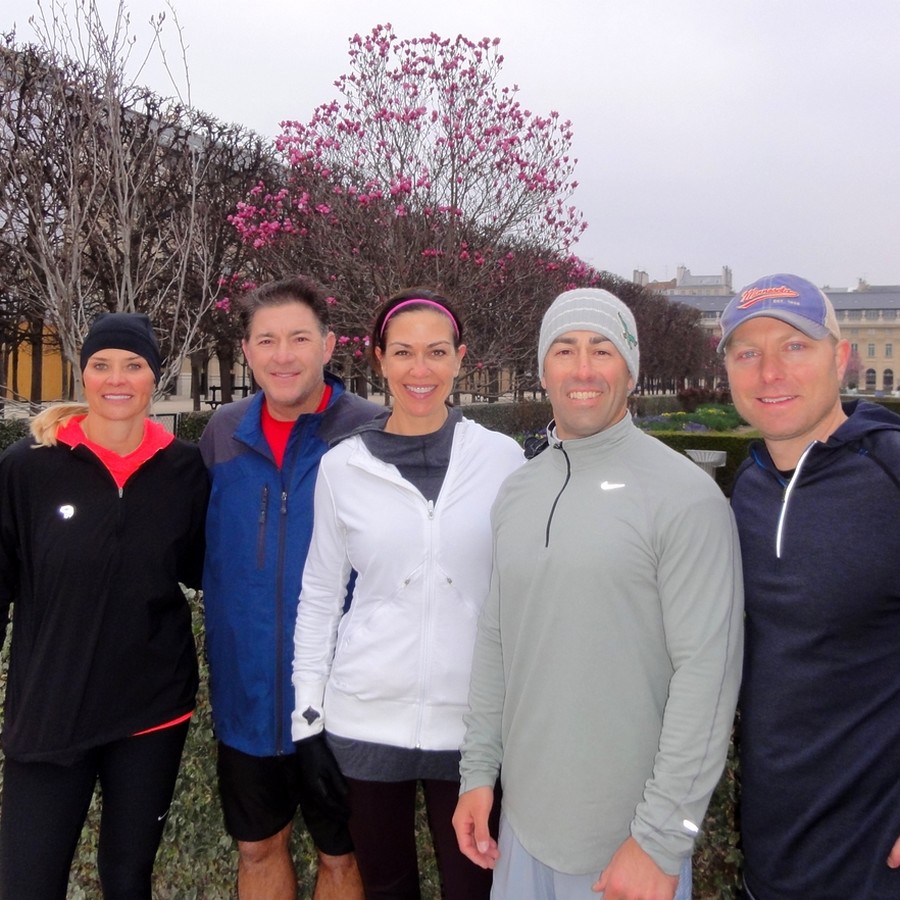
Marni, Marshall, Laura, Jason et Peter – Jardin du Palais Royal 7:00 AM – Marni, Marshall, Laura, Jason and Peter are runners-friends coming from the United States. Paris is still a little bit chilly in this early spring. Magnolias begin to bloom, as here in the garden of the “Palais Royal” (Royal Palace). Our sports visit begins in the garden of the Tuileries to arrive quickly at “place de la Concorde”, in front of the oldest monument of Paris, the Obelisk of Luxor: Jason, Marni, Laura, Marshall and Peter – “Place de la Concorde” – Obelisk of Luxor The Obelisk which we can see in the center of the “place de la Concorde” is more than 3000 years old. It comes from Egypt. The Pharaoh Ramses II had made two obelisks in the entrance of the Luxor temple, temple placed in the center of the old city of Thebes. The obelisk of “la Concorde” is one of them. In 1830, the viceroy of Egypt Mehemet-Ali offers to France the obelisks of Luxor. Then begins, for the first obelisk, an adventure which will last more than 6 years: the preparation of the operation, the cutting down of the obelisk, its transport towards Paris and its erection “place de la Concorde” in 1836, with all the troubles such an expedition can generate (heat, diseases, expectation of the Nile flood, navigation and transport difficulties, etc.) Cutting down of the Obelisk in 1831 (the other obelisk is situated to the left by looking at the temple) Erection of the Obelisk in 1836 “place de la Concorde” (The king Louis-Philippe and 200 000 Parisians attend the “show”) The other part of the “present”, the second Obelisk, remained in Luxor, France not wishing to launch again such an operation! Our visit continues along the Seine, the left bank then the right bank again. We cross the river Seine running on the “Pont des Arts”, the famous footbridge: Marshall, Laura, Marni, Jason and Peter – “Pont des Arts” In the background of the photo above, we can admire the “Galerie du bord de l’eau” of the Louvre. Did you know that in this long corridor, king Henri IV organized fox hunting for his son, future Louis XIII? We finish our running by returning by the garden of the Tuileries, very quiet in this morning of March: Merci Peter, Marni, Marshall, Jason and Laura ! The route of the tour :
Under the Eiffel tower with Rachel

Under the Eiffel Tower – Far off the Palais de Chaillot and the garden of Trocadéro 7:32 AM – Rachel, from Wales, is a regular runner with very good results… After the running tour in Paris, she arrived recently second woman of a half marathon. At present, she prepares for the next London Marathon. In this beginning of March, the sun is with us for an attractive tour of Paris by running. Look at the photo above, we are just under the Eiffel Tower. Early morning in March, the place is very quiet. Compare with the crowd that we can find on Easter Mondays for example or on a summer weekend there… Running early morning in Paris is a delight! Far off, on the other side of the Seine, we can recognize the majestic “Palais de Chaillot” which was built for the World Fair of 1937, last World Fair in Paris. The Palace of Chaillot replaced the Palace of Trocadéro built in the same place, that time for the World Fair of 1878: Aerial view of the “Palais du Trocadéro” – 1934 By the way, do you know what “Trocadéro” means? It is a fort which is situated in Cadiz in Spain and the place of a French victory; France came to help Spain to restore the absolute monarchy in 1823 (the king Louis XVIII reigns at that time in France). The Palace of the Trocadéro built in 1878 (and then the “Place du Trocadéro”) owes its name to a royalist victory! We went for running early, accompanied by the rising sun which lit for us the magnificent monuments of Paris: The Arc de Triomphe. We are in his shadow, the sun beginning to light the Champs-Elysées Palais Galliera Museum of the fashion with until, August 23rd, 2015, the exhibition dedicated to Jeanne Lanvin The Eiffel tower – We are at the “Palais de Chaillot”! The Alexandre III bridge with in the back the statue symbolizing the France of the Renaissance. At the top of the pylon, one of the four Fames: The Fame of the War. These four statues were covered with gold leaves in 1989. The Bridge of the Arts and in the back, the “Galerie du bord de l’eau” of the Louvre – The “Pont des Arts”, known these last years for all the padlocks which where put there by the loving tourists, is at present protected by wooden panels. These panels covered by graffitis spoil a little the beauty of the place. It should be temporary. The Palais Royal and its famous Columns of Buren (“Les deux plateaux”). The “Théâtre Ephémère” (short-lived theater) now disappeared. This wooden theater had welcomed temporarily the troop of the “Comédie Française” during the works of the “Palais Royal”. We can see again the garden of the “Palais Royal” through the columns. The Garden of the Tuileries – Our shadows are still very long! Merci Rachel ! We wish you a great London Marathon! The route of the tour:
“Place des Victoires” with Kristine
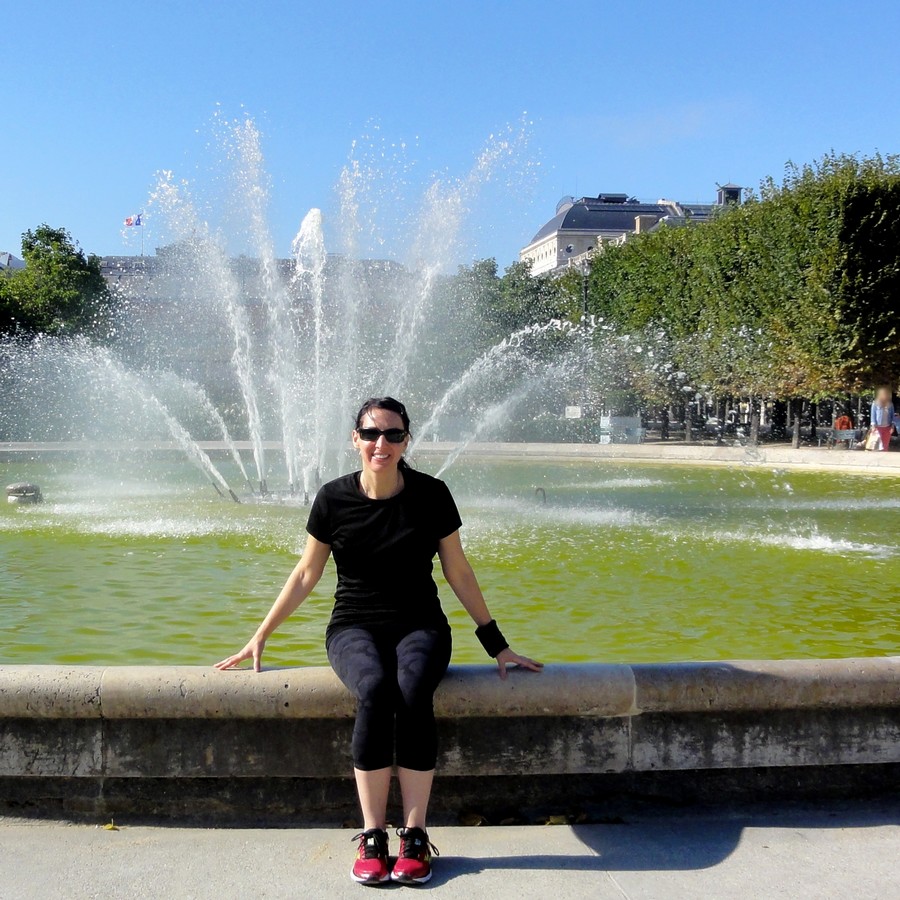
Kristine – Garden of the “Palais Royal” 10:05 AM – Kristine comes from New York. Very sports, she chose to take advantage of her stay in Paris to do a Running Tour and so combine sport and discovery of Paris. We left Grand boulevards to join the Eiffel Tower. At first, we ran in more intimate places as the garden of the Palais Royal (above) or the magnificent Parisian covered passages: We often spoke about them in this blog but it is always a great pleasure to discover these passages again. The second part of the route led us towards less “confidential” but great amazing places, as the banks of the Seine… Kristine – Banks of the River Seine (right bank, at the level of the “Jardin des Tuileries”) … or of course, the Eiffel tower: Kristine – Eiffel tower since the Avenue of the President Wilson Along the way, we crossed the magnificent “Place des Victoires” with the Statue of king Louis XIV, the Sun King. Kristine – Place des Victoires This square, created in 1685, was named “Place des Victoires” in honor of the military victories of Louis XIV. Do you know that the place saw successively four different monuments: from 1686 till 1792, a standing statue of Louis XIV from 1792 till 1810, a wooden pyramid from 1810 till 1828, a statue of General Desaix and since 1828, the current statue, an equestrian statue of Louis XIV. The first statue was melted in 1792 to make canons during the revolution. It represented King Louis XIV standing… … on a base representing four overcome nations (Spain, the Empire, Brandenburg and Holland): This base is visible in the Puget courtyard in the Louvre. We can even see it without entering the Louvre since the passage which connects the street of Rivoli with the Louvre Pyramid (remember the photo 12 in this article: here). Merci Kristine ! The route of the tour:
Some small secrets of the Parisian landscapes, with Kara
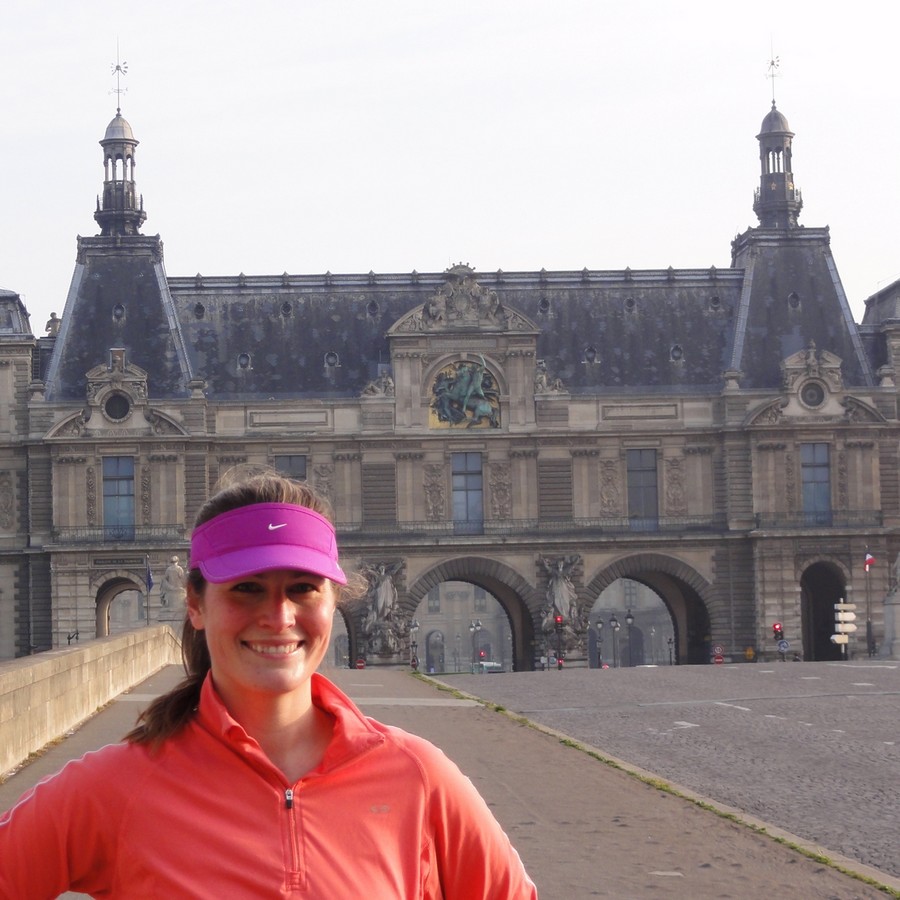
Kara – Bridge of the Carrousel 8:01 AM – With Kara, who comes from Atlanta (USA), we ran on an attractive route of more than 9 km and took advantage of the magnificent landscapes offered by Paris, emphasized by the sun which accompanied us this morning: splendid urban landscapes of Paris, buildings and monuments which revealed us small secrets during our running. For example on this photo of the Louvre taken since the bridge of the Carousel: do you see the lantern stands of the Pavilion of Lesdiguières which is at the right of the photo above? Let us look closer: Lantern of the Pavilion of Lesdiguières Golden “N” decorate the balcony of the lantern as on the one of the pavilion which faces it, the pavilion of Rohan. These “N” placed in the end of the Second Empire in the middle of the 19th century, honor the Emperor Napoleon III. But here, on the pavilion of Lesdiguières, these “N” are back to front! We think that the worker who put them, would have inverted them because of his hostility to Napoleon III! This small secret was discovered during the restoration of the Louvre museum in 1985, more than one hundred years after their installation! On the left, the lantern of the Pavilion of Rohan – On the right, the one of the Pavilion of Lesdiguières Not far from there, the famous Bridge of the Arts. Some tourists call it henceforth the “Love Padlocks” bridge*1… Kara – Footbridge of the Arts It is true that it is about one of the most romantic places of Paris, it would be only by its sight on the Island of the “Cité”. But what do we see if we get closer to the Island, behind the place Dauphine? A bird… A bird… It is one of the Imperial Eagles of the Justice Palace of Paris (Imperial Eagles dear to Napoléon the 1st, notice the “N” under the Eagle…): By pursuing our running in the Louvre, we decide to make a photo in the very beautiful squared courtyard (“Cour carrée du Louvre”): Kara – Cour carrée du Louvre Under our feet you can find the first Louvre, the Medieval Louvre, a fort protecting the West of Paris by strengthening the Outer wall of king Philippe Auguste. If you visit the basements of the Louvre, you can see the foundations of the medieval castle. Here is its representation and a photo of its foundations: Medieval Louvre – Foundations By leaving the Louvre, we go through the garden of Tuileries and its numerous statues: Kara – Garden of the Tuileries Notice for example, on the right-hand side of the photo above, the Statue of the Oath of Spartacus: By continuing along the historical axis of Paris, we arrive Place of La Concorde, magnificent place which really deserves a stop. Kara, “place de la Concorde” – In the axis, the Champs-Elysées with the “Arc de Triomphe” To the right, in the entrance of the Champs-Elysées, a rearing horse: one of the Horses of Marly. A copy of which the original is in the Louvre, original now protected from the vibrations provoked by the heavy machines of the National day military parade. Remember this article: Passing in front of the horses of Marly with Mary If we take a close look, we distinguish green flags. They are the flags of the Paris Marathon that took place five days earlier! Merci Kara ! The route of the tour: *1 The City hall of Paris recently decided to forbid the pose of these padlocks on buildings or bridges of Paris because they threaten and damage these Parisian heritage. Artists are requested to find a respectful replacement to these wild poses (Article France 3 – in French).
14 miles visiting Paris while running to prepare the New-York marathon, with Jess
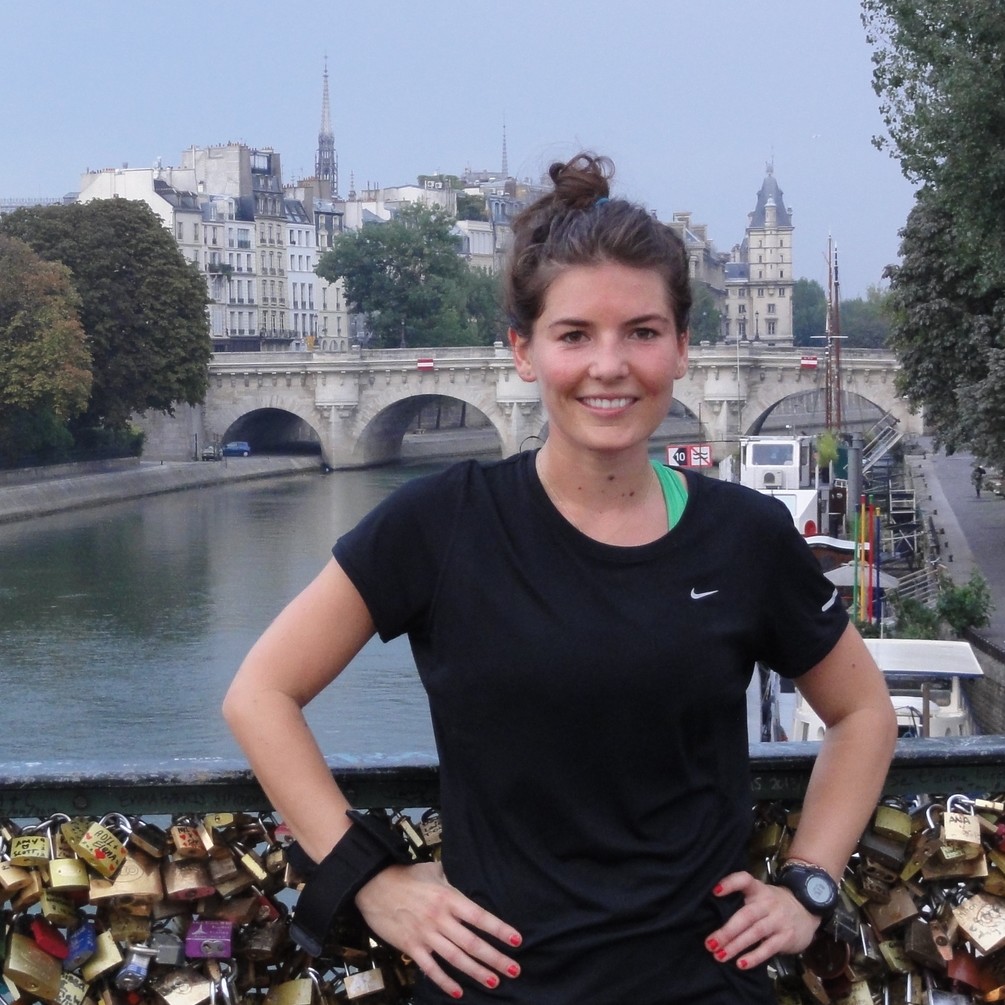
Jess – “Pont des Arts” (Bridge of the Arts) and view on the Island of the City (“île de la Cité”) 7h11 – Jess, marathon runner of New York (USA), in business trip in Paris, had two objectives by making a running tour: discover Paris and make a long run to prepare the New York marathon. We thus made a running of 14 miles (23 km) in Paris, distance which allows a beautiful visit of the city and the discovery of its numerous aspects. At first, a short pause to remember the objective, 26.2 miles (42.195 km) in New York: Jess – Avenue de New-York Then, from the avenue of New York, a small ascent (light preparation of the hilly New York marathon route) to join the Esplanade of the Trocadéro, the most beautiful view on the Eiffel Tower: Jess – “Esplanade du Trocadéro” We then leave the Eiffel Tower by the “Champ de Mars”: Jess – “Champ de Mars” Formerly used for military maneuvers, the Champ de Mars is now an ideal training ground for the runners: firm and supple hard-packed surface, buckle of 2 km, garden always opened (without railings), enlightened paths… Perfect circuit for the early morning runners! Much more east of Paris, it is on the sandy soil of the Lutetia arenas that we ran: Jess – “Arènes de Lutèce” Nowadays, we meet “pétanque” players or amateur soccer players there… About 2 000 years ago, there, we could see gladiators fighting, wild animals and also theater plays. Paris, at the time, was Roman and was called Lutetia. Of course, we did not miss numerous majors places of Paris, for example, the “Pont des Arts” (as we can see in the first photo of this article with its beautiful view on the Island of the City) or the Louvre Pyramid: Jess – The Louvre pyramid Since this sports stroll in Paris, Jess ran the marathon of New York with a beautiful performance. Paris Running Tour hopes to have contributed to this a little… 😉 Merci Jess ! The route of the tour :
Parisian perspectives with Karine
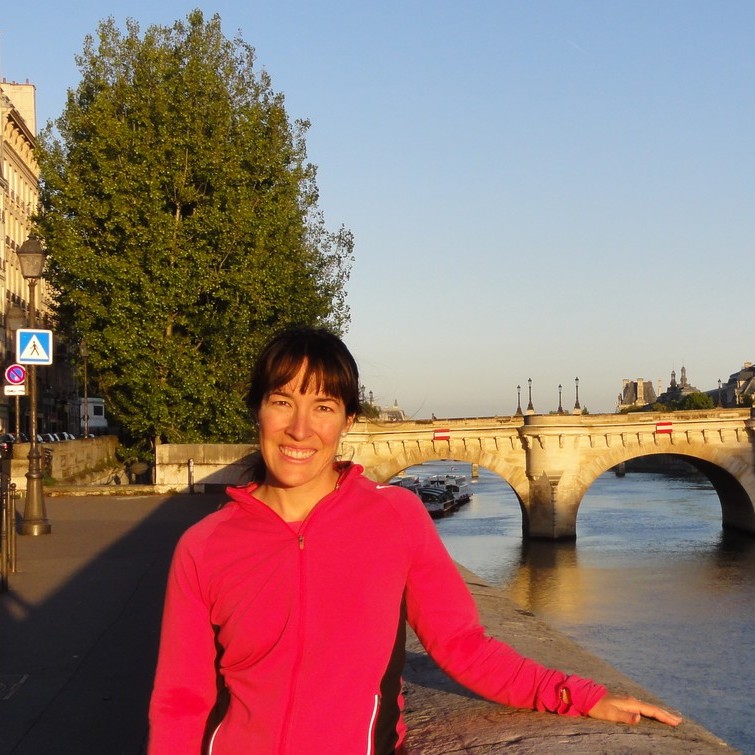
Karine – Le Pont Neuf (the New bridge) 7:00 AM – Karine, runner from Quebec, chose to make a Paris Running Tour to prepare the half marathon of Montreal, very close, and also, of course, to take advantage of the sports visit to discover the charm of a Parisian circuit. What beautiful perspectives offered by the morning sun! Look at the photo above with the light beginning to enlighten the “Pont Neuf” (New Bridge), the oldest bridge of Paris (See this article). We left early on this Sunday. At the start of the running, it was still dark. The silhouette of the Eiffel Tower appears in the dawn… Karine – Alexandre III bridge … as the Louvre, while the morning comes: Karine – The Museum of the Louvre seen from the left bank Still running towards the rising sun, we reached the Latin Quarter to meet the Sorbonne University: Karine – “Rue Saint Jacques” – The University of the Sorbonne (and its observatory) The Sorbonne goes follows the “rue Saint Jacques”, former Roman way. The building which we see is the third version of the Sorbonne and dates of the 1880s. The Sorbonne University was established in the XIIIth century by Robert de Sorbon. It is in the heart of the Latin Quarter. Latin Quarter? Hispanic district? No, no! In the Middle Ages, the students already came from the whole world to study there (among them, Dante, Erasmus). To speak together, a single shared language: the Latin! The passers-by eventually called the district Latin Quarter. A little later, we cross the “Pont des Arts” (bridge of the Arts), considered as one of the most romantic of Paris (remember the Padlocks…) What amazing perspectives on this bridge! Karine – Pont des Arts – Click to enlarge this panorama On the North side, the Louvre and the entrance of the “Cour Carrée” (Squared Courtyard), on the South side, the Institute of France, on the West side, the Orsay museum and the “Grand Palais” far off and lastly on the East side, the Island of “La Cité”, which cuts the river Seine with the point formed by the “Square du Vert Galant”. Later by leaving the Louvre, we discover the perspective onto the Opera of Paris, the Garnier Opera. The architect Charles Garnier had refused to see trees along the Avenue of the Opera so that the perspective onto his Opera is not spoiled. Karine – “Avenue de l’Opéra” On our way back, we cross the “Place de la Concorde”, look at both photos below, perspective onto the North and perspective onto the South: Karine – “Place de la Concorde” The church of “La Madeleine” and the National Assembly seem to be reflected. This was intentional. In 1806, Napoleon the 1st adopted the project of creation of a new facade for the former Palace of Duchess Louise of Bourbon, become “Assemblée Nationale” (National Assembly). This new Colonnade (link in French) of the facade reminds by its columns the facade of the Madeleine which faces it. A new axis is given to the facade forming an angle to the original axis of the Bourbon palace and finally, columns are raised by the steps of an impressive staircase so that the Bridge of “La Concorde” does not mask the sight on the bottom of the colonnade. Paris, always in the search for the harmony! Merci Karine ! The route of the tour :
A magnificent dawn in Paris with Marnie
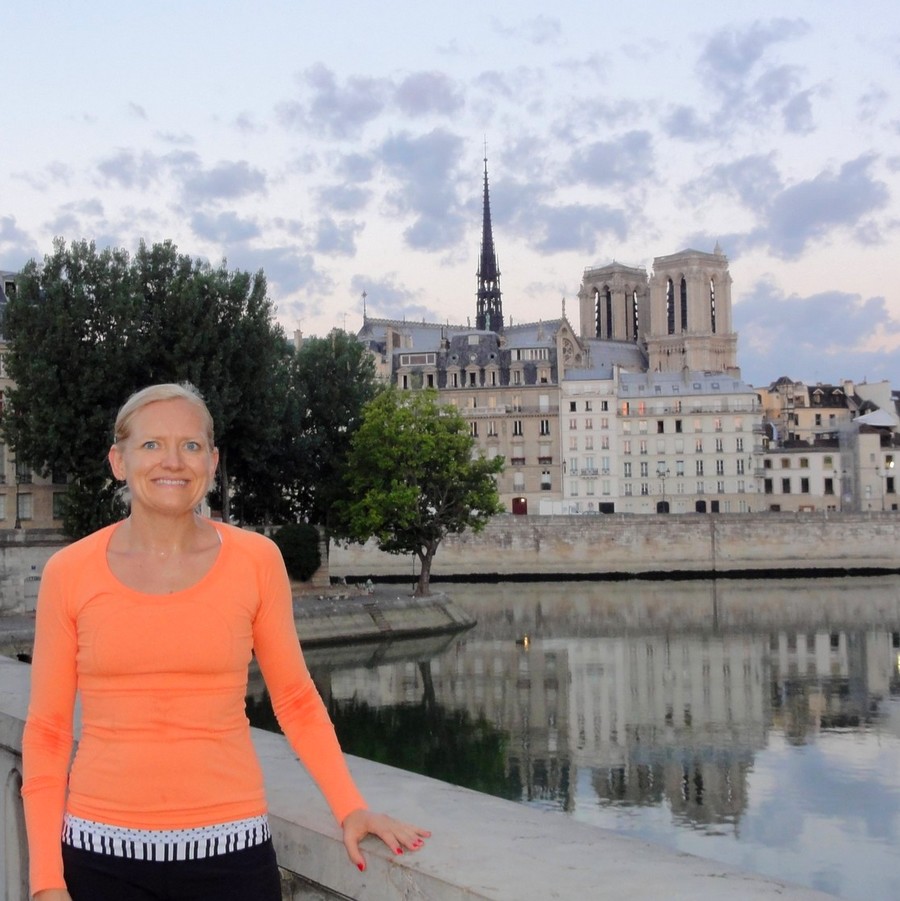
Marnie – “Pont Louis-Philippe”, on the left, “Ile St-Louis”, in the background, “Ile de La Cité” and Notre-Dame 5:52 AM – Marnie lives in Singapore. After having run several half marathons, Marnie prepares a marathon she will run this autumn. How to prepare a marathon while visiting Paris? A long tour with Paris Running Tour! Ideal to discover the city while doing our training. We thus traveled on a circuit of more than 18 km kilometers, with an amazing Parisian landscape parading under our eyes. We discovered a totally deserted Paris, embellished by the magnificent light of the rising sun. Deserted Paris? A start before 6 am + on Sunday + August! The Parisians went on holiday, tourists still sleeping, well parked cars. Paris only for us! Look on how the “Place de la Concorde” is deserted and beautiful in all the splendor of this summer morning: Marnie – “Place de la Concorde” Nobody in front of the “Palais de Justice” either… The Sainte Chapelle and Conciergerie, which surround it, are still in the quiet before the arrival of the visitors during the day. Marnie – The “Palais de Justice” of Paris, on the left, the “Sainte Chapelle”, on the right, the “Conciergerie” We ran along the river Seine which we crossed several times to benefit from beautiful points of view on Paris: Marnie – “Pont Neuf”, in the background, the “pont des Arts” Marnie – Footbridge Senghor, on the left, the Louvre, on the right the “Musée d’Orsay”, in the background, Notre Dame On the new banks of Paris, we made a little sprint to test the new new athletic track of one hundred meters: Marnie – New banks of Paris, athletic track of 100 meters Souvenir photo on the Esplanade of the Trocadéro, the best point of view to see the Eiffel Tower: Paris Running Tour – Marnie – The Eiffel tower – On the left, the dome of the Invalides Merci Marnie ! The route of the tour:
Around the Louvre with Janaina and Gustavo
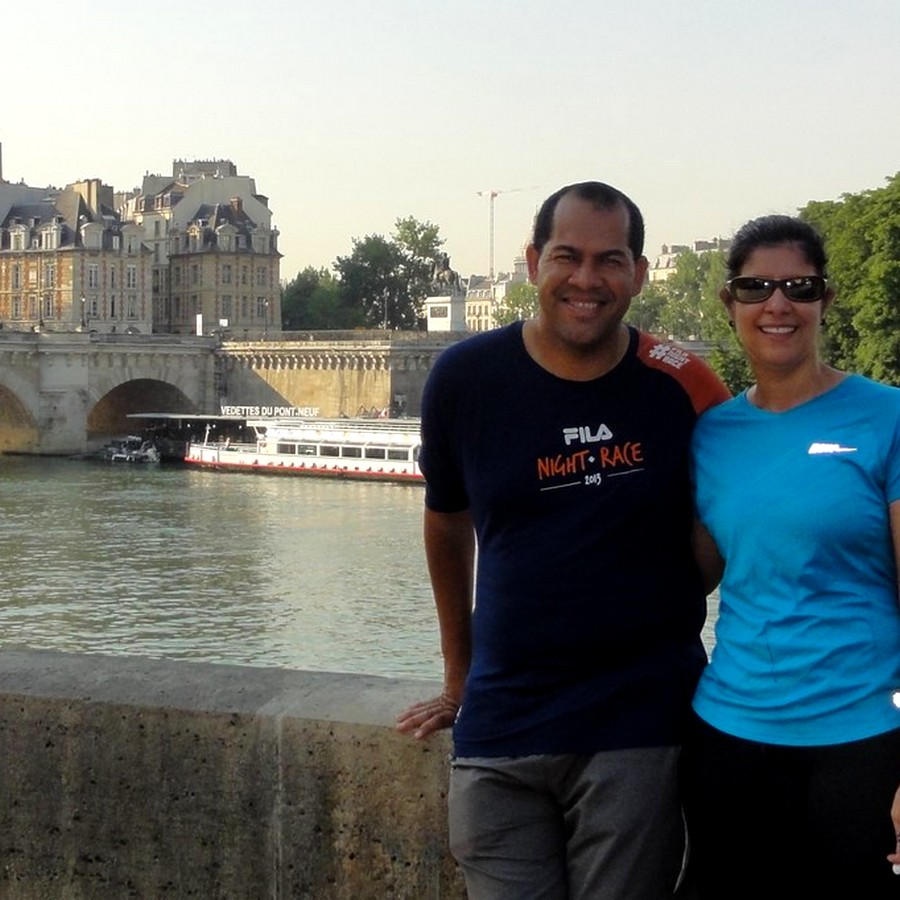
7:13 AM – Gustavo and Janaina live in Salvador (Brazil). To visit Paris by running, we chose a beautiful stroll around the Louvre. We left the Grands Boulevards and went through the “passage des Panoramas” (see the previous post), the “Palais Royal”, and then we joined the Louvre, by crossing the Street of Rivoli: The Passage Richelieu connects the street of Rivoli with the Louvre Pyramid and allows to see the beautiful sculptures of the Puget and Marly courtyards (remember the article which speaks about the horses of Marly) : After this small break in front of the passage Richelieu windows, we continued our running at the foot of the Pyramid, the magnificent glass pyramid which respects the central space of the Louvre and allows to see the Louvre in its totality: What was there before the Pyramid? A stand of trees where cars could park. At the foot of the trees, impossible to see all the facades: In the same direction, towards the garden of the Tuileries, we had a photo break to take advantage of the view on the Eiffel Tower, the “Musée d’Orsay” and also some statues of Maillol. Look for them in the bushes by enlarging the photo: We then left the garden of the Tuileries by way of the small tunnel which goes out of the garden by going towards the river Seine. We crossed the Seine by the footbridge Léopold Sédar Senghor and going up the staircases of the bridge, where we enjoyed a beautiful point of view on Notre-Dame: On the other side of the bridge, we saw the beautiful Palace of the Legion of Honor, cleaned recently (we had spoken about its replica in San Francisco here): Evoking the various places to run, we spoke about the immense and long beautiful beaches of Brazil. In Paris, we also have the opportunity to have some beaches 😉 At least from mid-July to mid-August, the banks of the “Right bank”, in particular, welcome the operation “Paris-Plages“: A little farther, near the Louvre, is the Louvre Oratory, with the Statue of the “Amiral de Coligny”, whose tragic end reminds us sad moments of the French History: On our road, we passed by the beautiful “Véro Dodat” gallery and we were amazed by the height of a famous Parisian shoemaker’s shoes (see below, near the passage, the Christian Louboutin’s first shop): Merci Janaina, merci Gustavo ! The route of the tour:
Running in the Parisian Passages with Michelle and Susan
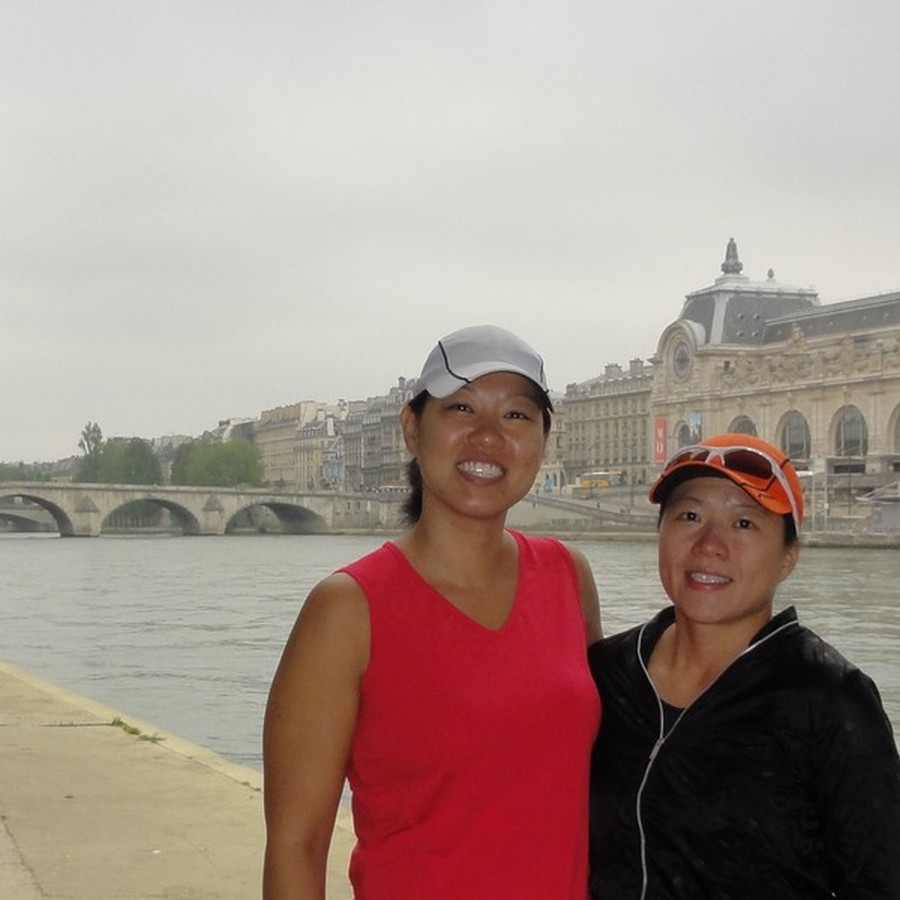
Susan and Michelle – The river Seine near the Tuileries garden, in front of the Orsay Museum 9:03 AM – Susan and Michelle are two New-York road-runners (NY – USA). Michelle prepares at present the Marathon of Chicago. After a first visit of Paris last year, their choice was for a little bit different route. We started near the Seine on the left bank. Look on the photo above, the new “emmarchement” in front of the Orsay Museum, “emmarchement” which is a part of the new banks of the Seine (very much enjoyed by runners). Having crossed the pedestrian footbridge Léopold-Sédar-Senghor, run in the Garden of the Tuileries and admired the place Vendôme, we were able to cross our first covered passage, the long passage Choiseul: Michelle, Susan – Passage Choiseul Not far from there, it is with pleasure that we met the beautiful “salle Favart”, National Theater of the “Opéra Comique” : Michelle and Susan – Opéra Comique It is the third “Salle Favart” built in 1898, both previous ones having burned. Second covered passage on our route, the Passage of the Panoramas, the oldest passage of Paris (we had already spoken about it here) : Susan, Michelle – “Passage des Panoramas” Just in front of the “Passage des Panoramas” is the Passage Jouffroy where a curious medieval character welcomes you: Susan and Michelle with a character of the Grévin Museum It is about one of the numerous wax characters of the Grévin Museum, the Parisian counterpart of Madam Tussauds of London. The entrance of the museum is situated in the Grand boulevards and the exit in the Passage Jouffroy. A little later, we found an old acquaintance, the Statue of Liberty (well, a Parisian younger sister…): Susan, Michelle – The Statue of Liberty in the museum of “Arts et Métiers” To know more about the Parisian statues of Liberty, click here. We continued our road and again crossed magnificent passages: “Passage du Grand Cerf” “Galerie Vero-Dodat” “Galerie Vivienne” These Parisian passages were approximately 150 in the middle of the 19th century, there are less than thirty nowadays. Our running allowed us to cross nine of them, among the most beautiful: We ended the tour by crossing the beautiful garden of the “Palais Royal”, isolated from the Parisian street by its long galleries of arcades, Michelle, Susan – Garden of the “Palais Royal” participated in the work of art constituted by the Columns of Buren (“Les deux plateaux” of the Artist Daniel Buren), On the columns of Buren in the “Palais Royal” and made a small break in front of the Louvre before crossing again the Seine to join the Left bank. Susan and Michelle – The Louvre museum Look on the Louvre Pyramid the sign of the Third Paradise, bound to The temporary exhibition of Michelangelo Pistoletto. Merci Susan, merci Michelle ! The route of the tour :
Snapshots of a first visit in Paris, with Melinda
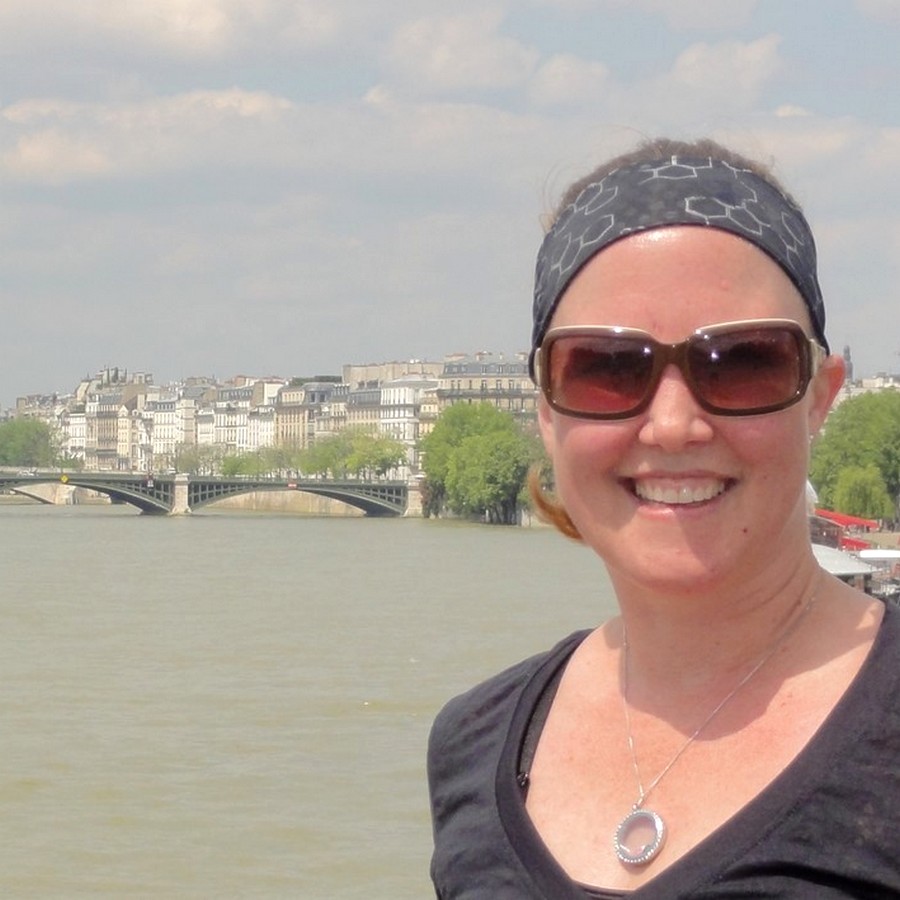
Melinda – On the bridge of Austerlitz. In the distance, Notre-Dame and Saint Louis Island beautiful houses Monday 27th May – 12:51 PM, Wednesday 29th May – 6:57 PM – First time in Paris for Melinda from Miami (USA) ! What better choice than to start a first stay in Paris doing a visit by running (with Paris Running Tour)? A good way of unwinding legs after a long travel by plane and a first discovery of Paris getting directly into the life of the city. And why not begin again two days later to discover new paths through Paris? We thus ran by following two routes which mainly crossed the disctrict of “Le Marais”, the Left bank, the island of “La Cité” and the center of Paris around the Seine. Here is the route (numbers indicate where the photos of this article were taken): We took numerous photos during our running: 1) “La rue des Barres” (Street of Bars). This name comes because formerly, in the 10th century, on the location of the street, a wall, a fence of wooden bars, constituted a wall protecting Paris: Melinda – “Rue des Barres” 2) “L’Hôtel de Sully” (The Hotel of Sully). The Duke of Sully, Minister of Finance of king Henri IV, lived in this noble mansion at the end of his life. By crossing the Hotel of Sully, we passed directly from the street Saint Antoine to the “place des Vosges”. Melinda – “Hôtel de Sully” 3) The “bassin de l’Arsenal”. Having crossed the place of the Bastille, we met the Basin of the Arsenal, port and canal connecting the river Seine with the Saint Martin canal and which, formerly, was a ditch which filled the moats of the castle of the Bastille. Melinda – “Port de l’Arsenal” 4) “Pont d’Austerlitz” (Bridge of Austerlitz). See the picture at the beginning of the article. 5) “Cour du Commerce Saint André”. Another place which is situated on the plan of the former surrounding wall of Paris, the wall of king Philippe Auguste. This passage, opened in 1776, allows to reach the Café Procope (1686), one of the oldest cafés in the world. Melinda – “Cour du Commerce Saint André” Second tour : 6) “Le Tribunal de Commerce de Paris” (Commercial court). This building presents the peculiarity to have a dome placed not in the center, but on the side, in a way that the dome is visible from the Boulevard Sevastopol. The dome closes the perspective of the Boulevard by the South. Melinda – On the bridge Notre Dame. We can see, on the island of “La Cité”, successively, the Hôtel-Dieu (Hospital), the “Tribunal du Commerce de Paris” and the Conciergerie. 7) On the “Pont Neuf” (“New” Bridge). Melinda – Pont Neuf. On left, the “Institut de France”, the Eiffel tower and, on right,the “Musée d’Orsay” 8) Colonnade of the Louvre. Summit of the French classicism, the Colonnade of the Louvre was realized at the request of king Louis XIV. The Colonnade of the Louvre served as model to numerous famous buildings, in particular, the Capitol of the United States in Washington, Metropolitan Museum of art in New York and San Francisco War Memorial Opera House. Melinda – The “Colonnade du Louvre” 9) Alexandre III bridge. The widest bridge in Paris. Built with the “Grand” and “Petit Palais” for the World Fair of 1900. The bridge offers a direct link between the “Invalides” and the Champs-Elysées. Melinda – the Alexandre III bridge – In the distance, the “Invalides” 10) The Champs Elysées. Melinda – Champs Elysées, at the end, the “Arc de Triomphe” and far off, the “Grande Arche” of “la Défense” 11) The equestrian statue of Joan of Arc, place of the Pyramids. She is situated not far from the Gate Saint Honoré, where Joan of Arc tried to cross Charles V’s surrounding wall to reconquer Paris, occupied at the time by the English. She was hurt by an arrow in the thigh there. Melinda – Equestrian statue of Joan of Arc, of Frémiet and inaugurated in 1874 12) The Puget courtyard in the Louvre. Melinda – Puget Courtyard, situated with the Marly Courtyard on both sides of the passage which connects the Louvre Pyramid to the street of Rivoli 13) Stravinsky fountain. This fountain, fountain Stravinsky or fountain of automatons, was created by the couple of artist Nikki de Saint Phalle and Jean Tinguely in 1983 and evokes the work of the composer Stravinsky. Melinda – the “Fontaine Stravinsky”, on the right George Pompidou Center Interesting and beautiful discoveries, isn’t it? Merci Melinda ! The route of the tours: