Running, understanding, having fun!

At Paris Running Tours, we love to run in Paris with the runners of the entire world. RUNNING in Paris with our guides, it is not simply running, it is also discovering how Paris is designed, how Paris became this great capital, it is discovering many aspects of Paris and how the different sites and locations are linked to each other, in a word… it’s UNDERSTANDING the city. Running, understanding, learning while running, it’s HAVING FUN. The miles go fast, your mind kept alive, “listening” to the city. At Paris Running Tours, we do private tours, specially prepared for you. This time, we had the pleasure to welcome a team of thirty young and fast american runners with their coaches. RUNNING, DISCOVERY and FUN were there. Let’s speak their team leader, LeRoy (review published in TripAdvisor): “We brought our high school girls cross country team to France for training, ending our last day with a Paris Running Tour guided run. If you want to measure the quality of a program, stress it to the max, and we did. We were 33 runners, and yet Jean-Charles and Sylvain guided us seamlessly and safely through the City. […] Throughout the event, Jean-Charles and Sylvain pointed out minute details about Paris that we never would have seen from a tour bus. Most importantly, they did a great job keeping us interested. I would highly recommend these guys.” RUNNING UNDERSTANDING HAVING FUN Click on the pictures to enlarge them A big thank to LeRoy and the whole team! If you too, you come to Paris, we will be very happy to run with you. Join us and discover Paris with authentic Parisians guides who always have tons of secrets to share with you:
Two early morning runs to discover Paris, with Agnes
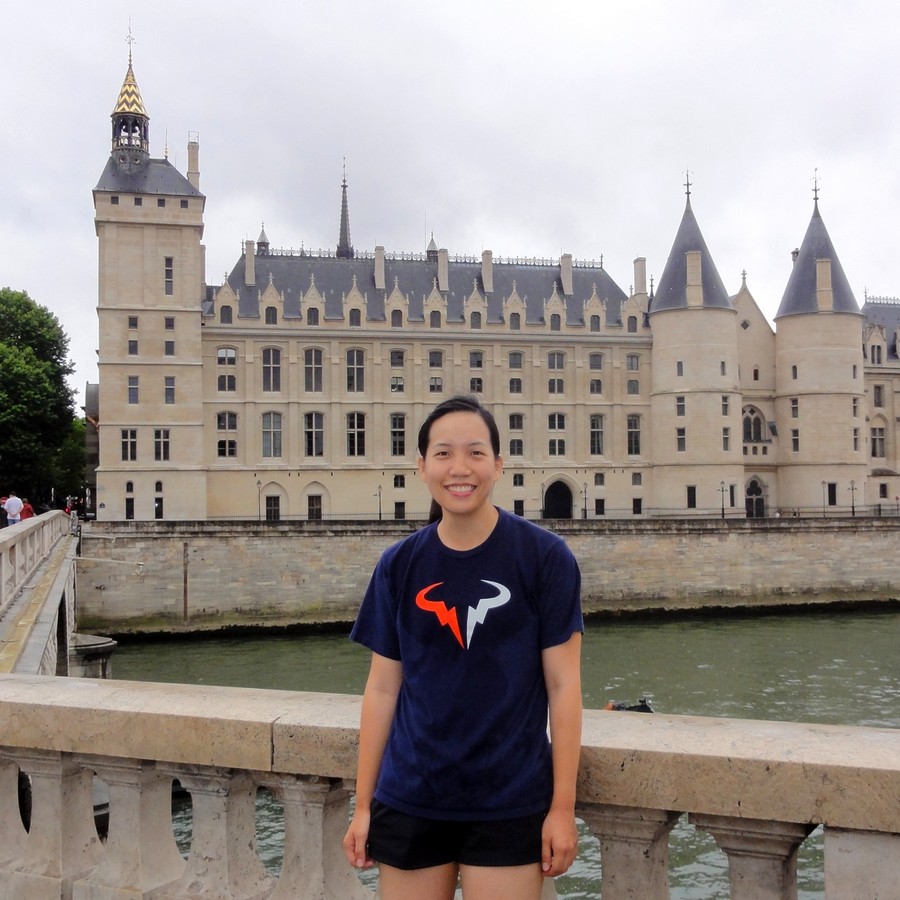
Agnes – Pont au Change – La Conciergerie Thursday 3 July 5:55 AM, Saturday 5 July 7:33 AM – Agnes lives in Los Angeles. Among the numerous visits which she foresaw to know Paris, Agnes included two Paris Running Tours, two morning visits to fully enjoy the capital. Indeed, it is a good means to understand the city landscape, discover numerous sites, to know its history and its architecture but also to apprehend its places, streets and squares in a sport way. First morning: A few minutes after the sunrise, a start not far from the Opera. Let us go to see the Eiffel Tower. Place of Concorde, we begin to see the tower far off: Agnes – Place de la Concorde – Behind the Obelisk, far off, the Eiffel Tower (notice the preparations for the National Day, on July 14th, with the stands which are going to welcome the government for the parade) Let us get closer. Place of the Alma, the Eiffel Tower is more and more visible: Agnes – Place de l’Alma with the Flame of Liberty, an exact replica of the Statue of Liberty’s flame and underneath, the famous tunnel of Alma In the background, the Eiffel tower Now, let us go to the Esplanade of the Trocadéro, one of the best locations to see the Eiffel Tower: Agnes – “Esplanade du Trocadéro” – The Eiffel tower, very close! Look at the landscape visible since the Esplanade, with in the background, on the left, Notre Dame, the Pantheon and the dome of the Invalides: Let us go towards Notre Dame. After a few kilometers of running, we can see the Cathedral, closer this time, since the bridge of the Carrousel: Agnes – Bridge if the Carrousel – Far off, on the Island of “La Cité”, the Saint-chapel and Notre Dame Second morning: Small rain this morning. Today, we are going to admire Notre Dame and the Pantheon. Let us cross the Bridge of the Arts (with a small “Hello” to the Eiffel Tower, far off): Agnes – “Pont des Arts” – Far off, the Eiffel tower We join the Pantheon and greet the great man recently arrived: Agnes – The Panthéon The Pantheon in restoration, as we can see it with these scaffolds on the photo, welcomes the exhibition of the artist JR. We follow our route to finally find the Cathedral “Notre Dame de Paris”: Agnes – Notre Dame – Notice on the ground, the marks which testify of the presence of a street (which existed until the middle of 19th century. Under the feet of Agnes, the mark of a church, Sainte Genevieve des Ardens) Before finishing our run, we cross another church, the Church Saint Eustache (built from 1532 till 1633): Agnes – Church Saint Eustache Funny detail, before the construction of the current church, stood a chapel (built at the beginning of the XIIIth century). This chapel was dedicated to Saint Agnès! Merci Agnes ! The routes of the tours:
In front of the Commercial court of Paris with Dave
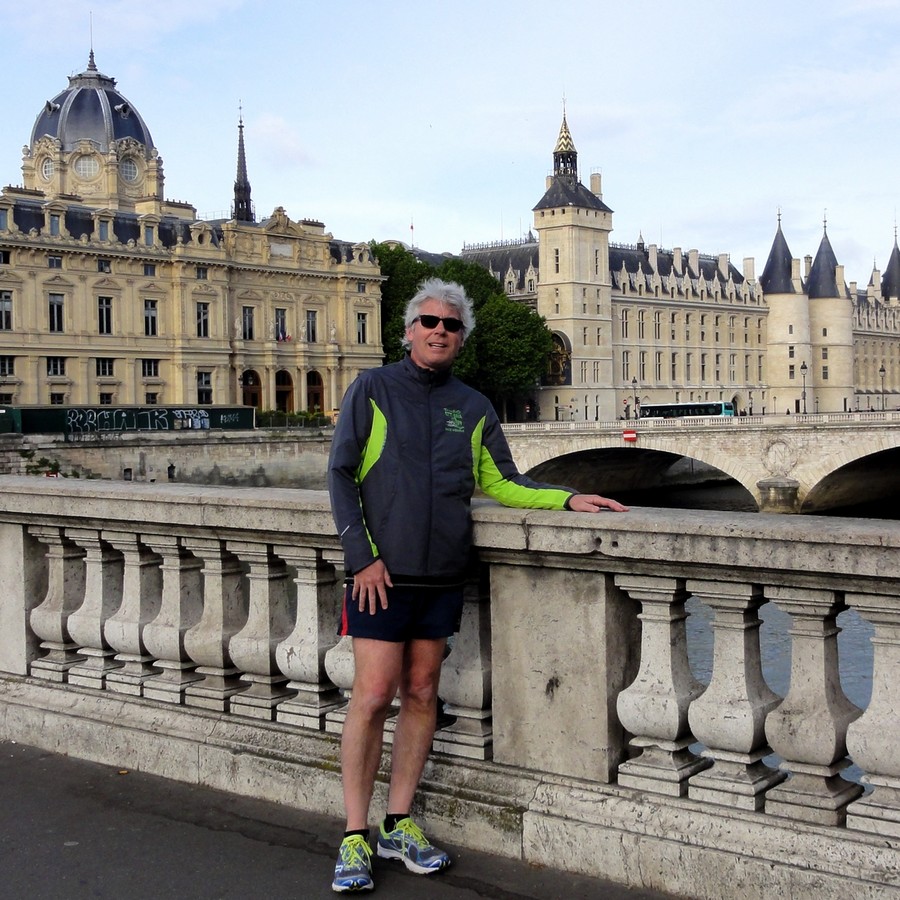
Dave – Bridge Notre Dame – In the background, on the left, the Commerce Court of Paris and on the right, the Conciergerie Thursday 1st May – 8:03 AM, Monday 12th May – 8:01 AM – Dave comes from the beautiful city of Ottawa in Canada. Two mornings to discover Paris in a sports way. A dive through the different layers of history which offers Paris. Paris is a city which was never destroyed contrary to Berlin (at the end of the war in 1945), Lisbon (earthquake of 1755) or London (fire of 1666), other leading cities. Paris can thus present as well Roman vestiges as buildings of the Middle Age either the numerous royal creations (among others!). Succession of architectural fashions, urbanistic traditions and most of the time a research for urban harmony. See, for example, above, the Commercial court (“Tribunal de Commerce”), in front of which we stopped. Let us look at it just in front: “Tribunal de Commerce” of Paris Something bizarre, no? The dome is not in the center of the building but on the right side! Architect’s whim? No, will of urban harmony. The dome is so placed to close on the South side the perspective of the Boulevard Sevastopol (perspective ended in the North by the train station of “Gare de l’Est”). The Commercial court is finished in 1864 while the Boulevard is inaugurated in 1858. Look at the precise alignment of the boulevard and the court: “Tribunal de Commerce de Paris” and Boulevard Sébastopol Let us pursue our running in the Middle Age Paris, with the magnificent Abbey of Cluny, now the National Museum of the Middle Age (and its Lady and the Unicorn famous tapestries): Dave – “Abbaye de Cluny” and the two old houses of the street François Miron: Dave – “Rue François Miron” Look at the wooden beams of the facade. These facades are rare in Paris. In fact, some old Parisian Middle age houses are hidden by renovations of facade. In 1967, The timber framings which we see here were cleared of the plaster which recovered them. Look at the buildings at the beginning of the 20th century: Indeed, in 1607, protective measures against the fires were decreed, in particular the obligation to cover with plaster timber framings (these measures were strengthened in 1667 because of the big fire of London in 1666!) Now, let us admire the beautiful perspective offered by the Soufflot street: Dave, “Rue Soufflot” (in the background, the Senate and the Eiffel Tower far off) – At the top of the Soufflot street, the Pantheon (The street name is the one of Jacques-Germain Soufflot, architect of the Pantheon) Merci Dave ! The routes of the tours:
Medieval art, Art nouveau, Modern Art, 10 miles (16 km) in Paris with Lysa
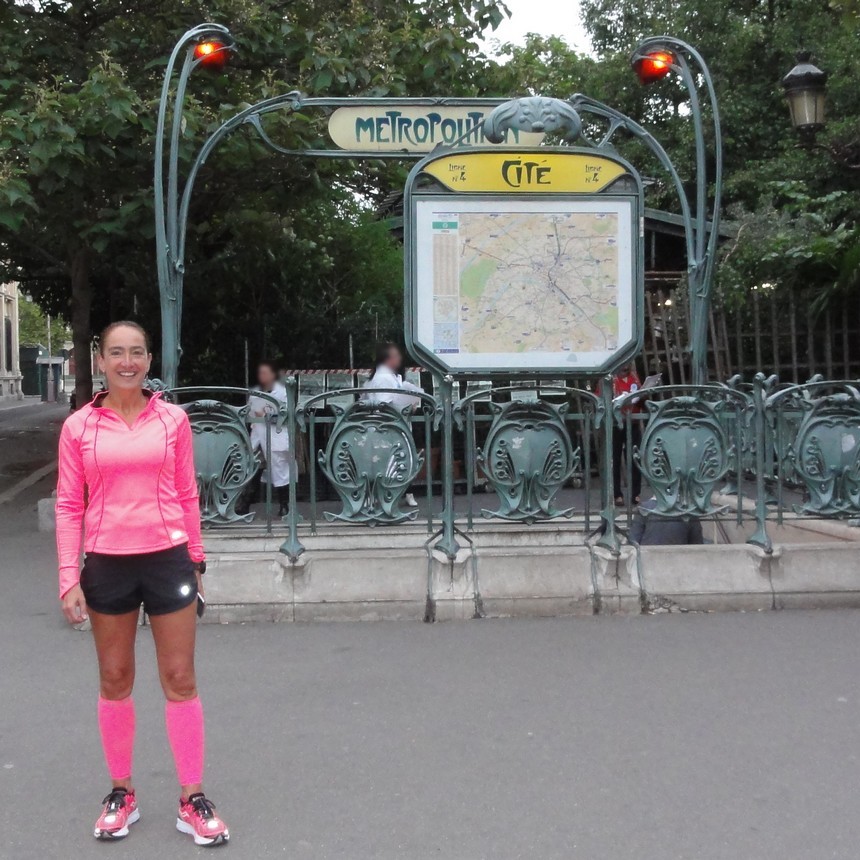
Lysa – Ile de la Cité (Island of the City) 7:03 AM – With Lysa, from Buffalo (New York), we made a 10 mile run (16 kilometers) to discover the numerous artistic facets of Paris. More than 2000 years of History… and artistic and architectural creations! Did you notice the numerous Parisian metro entrances with these arabesques forms, as the one that we see on the photo above next to Lysa? These entrances are typical artistic creations of the beginning of the 20th century, this art which we called the “Art Nouveau”. The creator, Hector Guimard, very representative artist of the “Art Nouveau” movement, realized 141 of these entrances of the Parisian subway from 1900 till 1912. Some entrance are even covered with a glass roof. Today, there are only 86 left, 2 with a glass roof as the “Porte Dauphine” one (West of Paris on the Avenue Foch): Hector Guimard’s subway entrances were offered to the subways of other cities as Montreal, Mexico City, Chicago, etc. There is even one in the Washington National Gallery of Art! Still on the Island of “La Cité”, we also admired two Medieval Art examples (vast ensemble of the Middle Ages Arts, covering a period of 1000 years): The famous Cathedral Notre-Dame-de-Paris, representative of the Gothic Art: Lysa and the Cathedral “Notre Dame de Paris” (on the left, the temporary installations celebrating 850 years of Notre-Dame) The Clock of the Conciergerie (for more information, read this article) : Lysa – Tour de l’Horloge (tower of the Clock) Further west, we met two forms of more recent arts: A plant wall! One of the first green walls realized by Patrick Blanc, who invented the concept of plant walls. This one was created in 2004, on one of the Quai Branly Museum administration building walls: Lysa – Vegetation wall (Patrick Blanc 2004) And of course, the famous Iron tower, the Eiffel Tower! The Tower was built for the World Fair of 1889. From 1889 to 1931, it was the highest monument in the world. During its construction, it was very criticized, but obtained a big success during the world fair of 1889, success which fell rather fast (in spite of a renewal of curiosity during the World Fair of 1900) We even intended to destroy it… It is now the most emblematic symbol of Paris! Lysa – Eiffel tower It’s a pleasure to run in Paris! Merci Lysa ! The route of the tour:
A magnificent dawn in Paris with Marnie
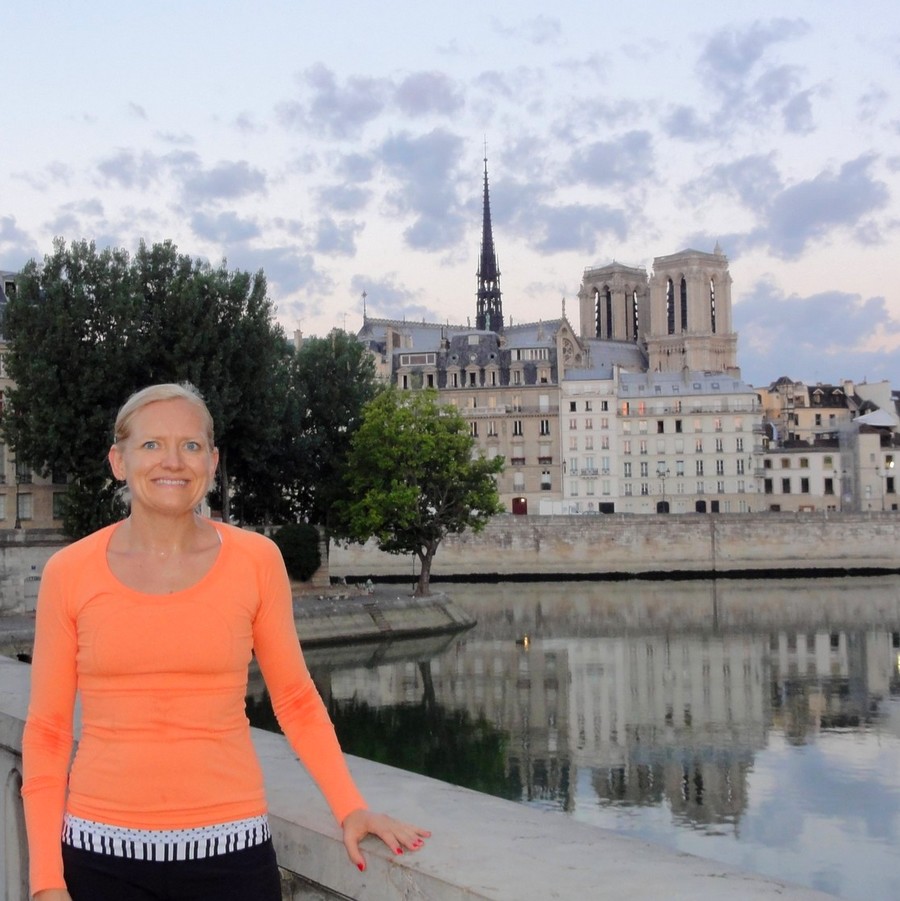
Marnie – “Pont Louis-Philippe”, on the left, “Ile St-Louis”, in the background, “Ile de La Cité” and Notre-Dame 5:52 AM – Marnie lives in Singapore. After having run several half marathons, Marnie prepares a marathon she will run this autumn. How to prepare a marathon while visiting Paris? A long tour with Paris Running Tour! Ideal to discover the city while doing our training. We thus traveled on a circuit of more than 18 km kilometers, with an amazing Parisian landscape parading under our eyes. We discovered a totally deserted Paris, embellished by the magnificent light of the rising sun. Deserted Paris? A start before 6 am + on Sunday + August! The Parisians went on holiday, tourists still sleeping, well parked cars. Paris only for us! Look on how the “Place de la Concorde” is deserted and beautiful in all the splendor of this summer morning: Marnie – “Place de la Concorde” Nobody in front of the “Palais de Justice” either… The Sainte Chapelle and Conciergerie, which surround it, are still in the quiet before the arrival of the visitors during the day. Marnie – The “Palais de Justice” of Paris, on the left, the “Sainte Chapelle”, on the right, the “Conciergerie” We ran along the river Seine which we crossed several times to benefit from beautiful points of view on Paris: Marnie – “Pont Neuf”, in the background, the “pont des Arts” Marnie – Footbridge Senghor, on the left, the Louvre, on the right the “Musée d’Orsay”, in the background, Notre Dame On the new banks of Paris, we made a little sprint to test the new new athletic track of one hundred meters: Marnie – New banks of Paris, athletic track of 100 meters Souvenir photo on the Esplanade of the Trocadéro, the best point of view to see the Eiffel Tower: Paris Running Tour – Marnie – The Eiffel tower – On the left, the dome of the Invalides Merci Marnie ! The route of the tour:
Snapshots of a first visit in Paris, with Melinda
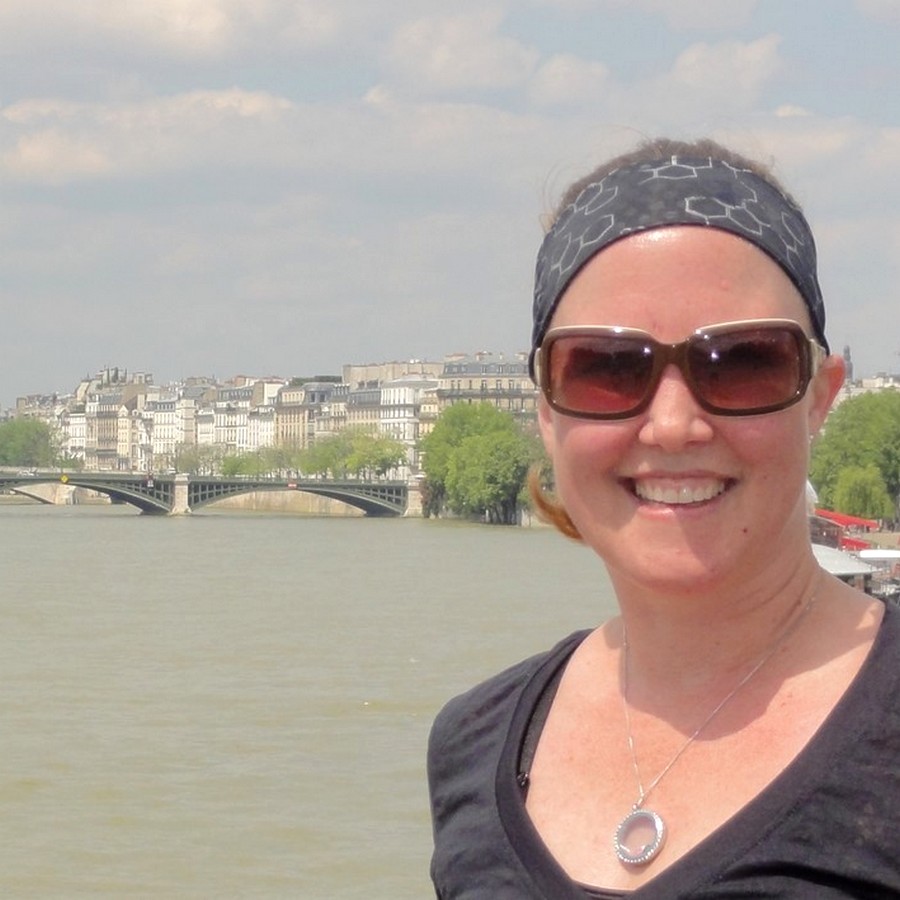
Melinda – On the bridge of Austerlitz. In the distance, Notre-Dame and Saint Louis Island beautiful houses Monday 27th May – 12:51 PM, Wednesday 29th May – 6:57 PM – First time in Paris for Melinda from Miami (USA) ! What better choice than to start a first stay in Paris doing a visit by running (with Paris Running Tour)? A good way of unwinding legs after a long travel by plane and a first discovery of Paris getting directly into the life of the city. And why not begin again two days later to discover new paths through Paris? We thus ran by following two routes which mainly crossed the disctrict of “Le Marais”, the Left bank, the island of “La Cité” and the center of Paris around the Seine. Here is the route (numbers indicate where the photos of this article were taken): We took numerous photos during our running: 1) “La rue des Barres” (Street of Bars). This name comes because formerly, in the 10th century, on the location of the street, a wall, a fence of wooden bars, constituted a wall protecting Paris: Melinda – “Rue des Barres” 2) “L’Hôtel de Sully” (The Hotel of Sully). The Duke of Sully, Minister of Finance of king Henri IV, lived in this noble mansion at the end of his life. By crossing the Hotel of Sully, we passed directly from the street Saint Antoine to the “place des Vosges”. Melinda – “Hôtel de Sully” 3) The “bassin de l’Arsenal”. Having crossed the place of the Bastille, we met the Basin of the Arsenal, port and canal connecting the river Seine with the Saint Martin canal and which, formerly, was a ditch which filled the moats of the castle of the Bastille. Melinda – “Port de l’Arsenal” 4) “Pont d’Austerlitz” (Bridge of Austerlitz). See the picture at the beginning of the article. 5) “Cour du Commerce Saint André”. Another place which is situated on the plan of the former surrounding wall of Paris, the wall of king Philippe Auguste. This passage, opened in 1776, allows to reach the Café Procope (1686), one of the oldest cafés in the world. Melinda – “Cour du Commerce Saint André” Second tour : 6) “Le Tribunal de Commerce de Paris” (Commercial court). This building presents the peculiarity to have a dome placed not in the center, but on the side, in a way that the dome is visible from the Boulevard Sevastopol. The dome closes the perspective of the Boulevard by the South. Melinda – On the bridge Notre Dame. We can see, on the island of “La Cité”, successively, the Hôtel-Dieu (Hospital), the “Tribunal du Commerce de Paris” and the Conciergerie. 7) On the “Pont Neuf” (“New” Bridge). Melinda – Pont Neuf. On left, the “Institut de France”, the Eiffel tower and, on right,the “Musée d’Orsay” 8) Colonnade of the Louvre. Summit of the French classicism, the Colonnade of the Louvre was realized at the request of king Louis XIV. The Colonnade of the Louvre served as model to numerous famous buildings, in particular, the Capitol of the United States in Washington, Metropolitan Museum of art in New York and San Francisco War Memorial Opera House. Melinda – The “Colonnade du Louvre” 9) Alexandre III bridge. The widest bridge in Paris. Built with the “Grand” and “Petit Palais” for the World Fair of 1900. The bridge offers a direct link between the “Invalides” and the Champs-Elysées. Melinda – the Alexandre III bridge – In the distance, the “Invalides” 10) The Champs Elysées. Melinda – Champs Elysées, at the end, the “Arc de Triomphe” and far off, the “Grande Arche” of “la Défense” 11) The equestrian statue of Joan of Arc, place of the Pyramids. She is situated not far from the Gate Saint Honoré, where Joan of Arc tried to cross Charles V’s surrounding wall to reconquer Paris, occupied at the time by the English. She was hurt by an arrow in the thigh there. Melinda – Equestrian statue of Joan of Arc, of Frémiet and inaugurated in 1874 12) The Puget courtyard in the Louvre. Melinda – Puget Courtyard, situated with the Marly Courtyard on both sides of the passage which connects the Louvre Pyramid to the street of Rivoli 13) Stravinsky fountain. This fountain, fountain Stravinsky or fountain of automatons, was created by the couple of artist Nikki de Saint Phalle and Jean Tinguely in 1983 and evokes the work of the composer Stravinsky. Melinda – the “Fontaine Stravinsky”, on the right George Pompidou Center Interesting and beautiful discoveries, isn’t it? Merci Melinda ! The route of the tours:
Running in Paris at the sunrise, with Denise
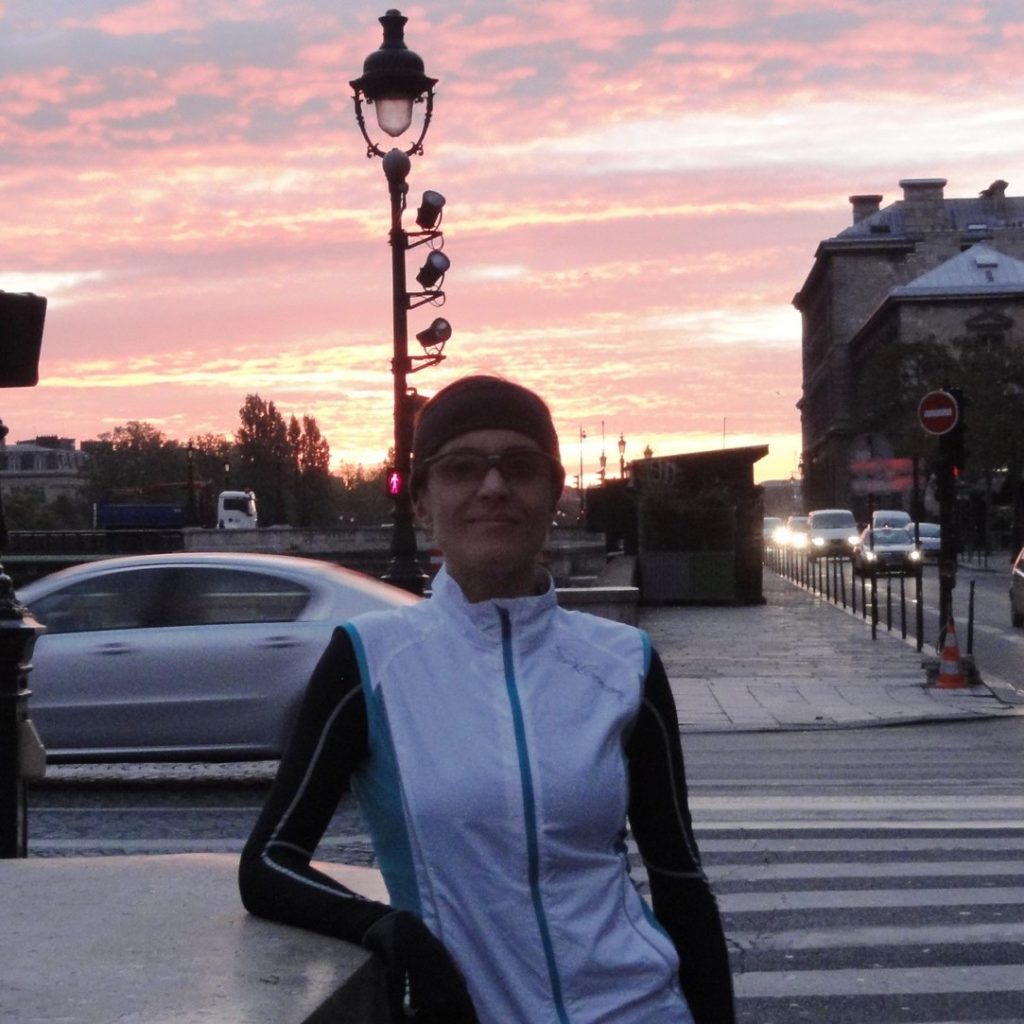
Denise – “Quai de l’Horloge” (Pier of the Clock) 6:58 AM – With Denise from Porto Allegre (Brazil), we start running early. We took advantage of the morning light to admire streets and monuments and see the city waking up. While staying near the Seine, we visited the center of Paris by alternating the right bank and the left bank: the Latin Quarter, Saint Germain des Près, the “place de la Concorde”, the Louvre, without forgetting the Island of the City (as shown on the photo above, Quay of the Clock, at the foot of the Horloge of the Conciergerie, recently renovated). We made a small detour on the “Pont des Arts” to appreciate the rays of the sun enlightening the West of Paris: Denise – Pont des Arts A little later, we found the Garnier Opera, quite enlightened by the daylight: Denise, avenue de l’Opéra The avenue of the Opera, created during the works of Hausmann, had initially been planned with trees. Charles Garnier, the architect, did not want these trees. He had wished that the sight of his Opera was completely unobstructed. Without trees, the Opera is indeed very visible since the place André Malraux near the Louvre. Denise – Mairie of the 1st arrondissement (1st district city hall) and the church Saint-Germain-l’Auxerrois A little farther, we met two buildings. They are alike, right? If they have the same architecture, they have nevertheless very different uses. One is a public building: the City hall of the 1st district and the other one, a religious building: the church Saint-Germain-l’Auxerrois. This group owes its existence to a particular history: August 24th, 1572, in full religious war, bells of this very old church gave the order to eliminate all the Protestants of Paris. This signal was the beginning of the horrible Saint-Bartholomew’s massacre. In the 19th century, town planners made the project to extend eastward the historic axis Louvre-Tuileries-Concorde-Champs Elysées. It should cause the destruction of the church. The baron Haussman, in charge of the big Parisian works, refused. Indeed, as he was Protestant, he did not wish that people can interpret the destruction of the church as a personal vengeance. He also asked for the construction of a city hall, completely similar to the church, by concern of harmony. He made raise between both buildings a tower-bell to strongly separate the “religion” and the “republic”. Parisians, derisive, called the group “L’huilier et ses deux burettes” (the hand oiler and the two cruets). We finished our running by way of the Island of the City and the Latin Quarter. About 11 km, sports and instructive! Merci Denise ! The route of the tour :
In front of the renewed Conciergerie with Greg
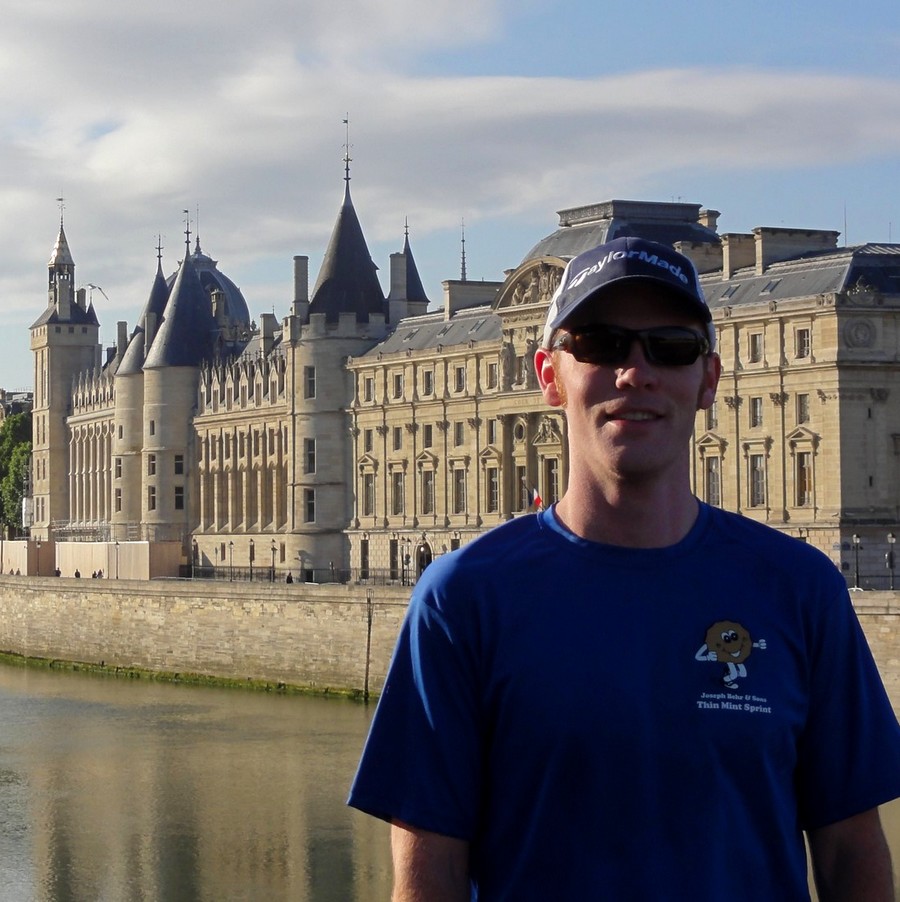
Greg – The Conciergerie 7:01 AM – Greg lives not far from Chicago. At this rather rainy end of spring in Paris, we were lucky to have a pleasant sun on this Sunday morning. We ran by crossing a circuit which led us of the Discovery Palace to the Pantheon, by way of the Conciergerie. Important works, which lasted more than one year, allowed to renew completely the Conciergerie. Until recently, the Conciergerie was covered with scaffolds that hid gigantic advertisements. We were thus able to discover the beautiful Conciergerie, with clean and clear walls. The roof of the “Tour de l’Horloge” (Clock tower) was redone, it is now golden: Tour de l’Horloge – Conciergerie The Conciergerie belonged to the Palace of “la Cité”, residence of kings of France in the Middle Ages, palace which succeeded to the Roman Emperors palaces in Paris. The palace was abandoned by kings at the end of the fourteenth century, the Conciergerie became then a prison, the most famous prisoner being queen Marie-Antoinette. Conciergerie? Concierge? Yes, the word comes from there. The Concierge was an important person appointed by the king to maintain the order, manage the police, take care of prisoners, do the justice… He lived in the Conciergerie. The word Concierge comes from the Latin word Conservius, “companion of slavery”, the one who serves the Palace. Nowadays, we use now the term “Conciergerie” to name the whole palace. On the way, we noticed the numerous flags on public buildings, as we can see on the photo of the Pantheon below: Greg – The Panthéon Yes, Sunday, June 17th, 2012 was day of elections in France, the second ballot of the general election. Visit the Pantheon, this temple dedicated to the persons celebrated by the Nation. In the crypt, we find, among others, the graves of Voltaire, Rousseau, Victor Hugo, Marie Curie. The ground floor exposes the paintings which describe the life of Geneviève, protector of Paris. Do not miss to rise to the dome which offers a magnificent view on Paris. Look at the pediment, so allegorical. In the center, the Nation, with on its right, the Freedom and on its left, the History. On the side of the Freedom, the heroes of the civil order celebrated by the Revolution. Among them, you can find Voltaire and Rousseau, sat. On the side of the History, is the military order. We can see the young Bonaparte, future Napoleon 1st. A beautiful running before the opening of polling stations! Merci Greg ! The route of the tour: