Around the flooded Seine with Robin

During our Paris running tour with Robin from Ohio, we discovered a Paris that is still as beautiful as ever, but surprising, with an amazing new landscape, the flooded river Seine. This is not the first flood we are experiencing in Paris, remember the very recent flood of June 2016, which was only slightly higher than this one of January 2018. We talked about it during our visit of Paris with Molly and Saul. Small floods also appear from time to time, for example, here in 2013. Together With Robin, we discussed the various aspects of this flood, the 100-year floods, the unusual extent of the Seine and its effects on banks, boats and even gardens, such as the almost totally submerged “Jardin du Vert Galant” (see photo above). We also talked about our marathon experiences, Robin’s qualification for Boston, the Paris Marathon and the beauty of its route. Below, the famous unofficial indicator of the level of the Seine, the “Zouave du Pont de l’ Alma”, with the water up to mid-thigh. We had talked about it here (with the different levels of the Seine in relation to the statue…). Our visit took us to the heights, less threatened by the flooding of the Seine, for example, the “Montagne Sainte-Geneviève”, at the top of which stands the Pantheon: Facing the Pantheon, the Faculty of Law, which trains future jurists. Merci beaucoup Robin ! If you too, you come to Paris, we will be very happy to run with you. Join us and discover Paris with authentic Parisians guides who always have tons of secrets to share with you:
Memories of 2017, very good moments with our visitors (2/3)

Here is the second article of the end of this year serie, which reviews some of the Parisian visits made with our sports visitors. It was a great pleasure to run with Carla, Ashley and Jen from San Francisco, end of September. A good distance allowed us to discover all the diversity of Paris. The following pictures show some aspects of this variety. If you too, you come to Paris, we will be very happy to run with you. Join us and discover Paris with authentic Parisians guides who always have tons of secrets to share with you. Enjoy an original private tour, tailor-made for you:
2013-2017 – A new great discovery of Paris with Colleen

At Paris Running Tours, we are very happy to have the opportunity to run with the runners of the entire world and proud to share our love for Paris with them. We are glad when they renew their confidence in us by running with us again. Of course, therefore, we create a different route from the one of last time. Colleen from Arizona, who ran with us in 2013 came back this year and it was with a great pleasure that we met her again. Meanwhile, Paris changed: Look the photo above. The famous “Love padlocks” left the “Pont des Arts”. The right Banks which in 2013 were only for cars, are now for pedestrians only, an ideal location for the runners and also a magnificent place to admire the Island of the river Seine in Paris: On these same banks, we also enjoyed the possibility to look into the past of the Paris of the 17th century, thanks to this marvelous invention, the Timescope, recently appeared in Paris (also “Place de la Bastille”): Passing by the “Invalides” again, we easily saw the rabbits of the “Hôtel des Invalides” frolic under the gaze of the Eiffel tower (less visible in 2013, it’s the progeny of couple of rabbits established here in 2010) : During our sport stroll, we also met other animals, wallabies, a whale, a stegosaurus, a mammoth. At the entrance of the “Jardin des Plantes”, two impressive lions welcomed us: The other lion, hidden by the trees in the photo above, is really surprising… look at the strange fantasy created by the sculptor (but what is sniffing this lion?) : Merci Colleen ! You come to or you are in Paris, we will be very happy to run with you. Come and discover Paris with authentic Parisians guides who always have tons of secrets to share with you:
Chestnut trees in flowers, place Dauphine, with Lena
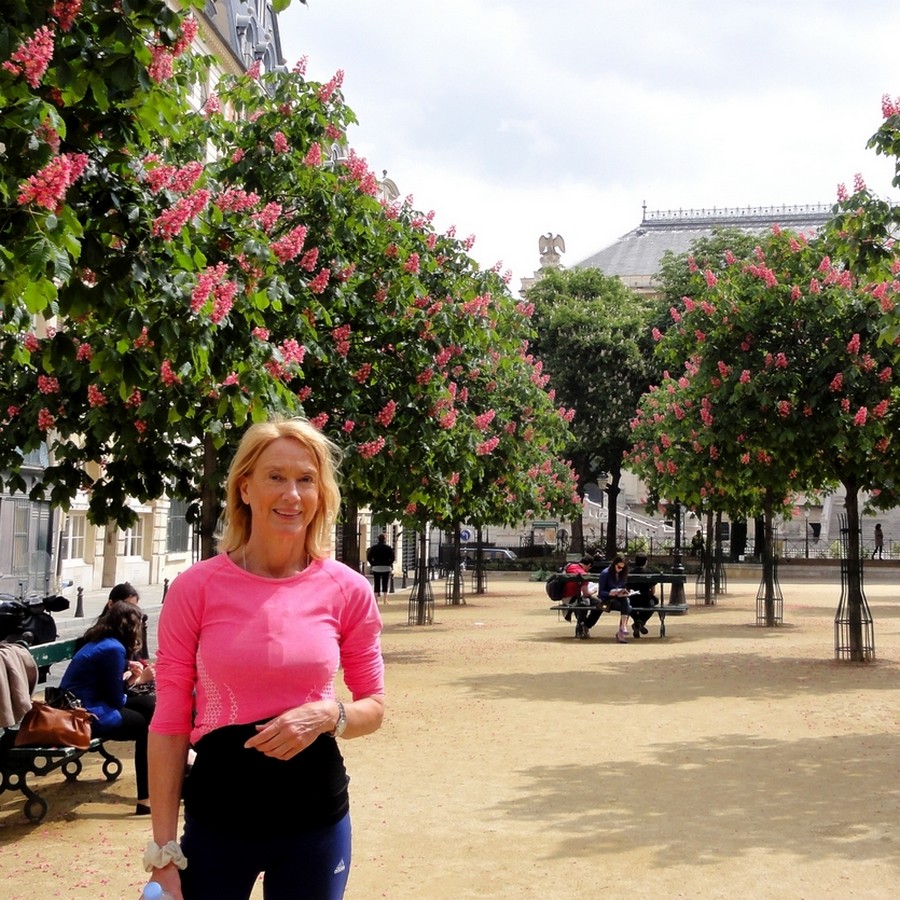
Lena – Place Dauphine 11:03 AM – Lena comes from Sweden. While running, we discovered a Paris colored by the spring. Look at the photo above where the Place Dauphine shows proudly its chestnut trees in flower. Created shortly after the “Place des Vosges” (at that time, Place Royale), the Place Dauphine owes its name to the son of king, the “Dauphin”, future Louis XIII, son of Henri IV whose we can see the statue on the west of the Place. Beautiful small quiet square, opened on the Justice Palace, it was until 1874 a square closed by a third side of buildings. The Place was then a complete triangle. Before and after Here are the buildings which constituted the basis of the triangle: Place Dauphine before 1874 – East side – No trees at the time! Other beautiful trees and vegetables accompanied our route: The oldest tree in Paris Lena – Locust tree (Robinia pseudoacacia) planted in 1602 (Square René Viviani) The plant wall which covers a part of the buildings of the Quai Branly Museum Lena – Plant wall created in 2004 by Patrick Blanc (Administrative buildings of the Quai Branly Museum) The trees which follow the new banks of the Seine Lena – Banks of the river Seine (left bank) – In the background, the Eiffel Tower Merci Lena ! The route of the tour :
Some small secrets of the Parisian landscapes, with Kara
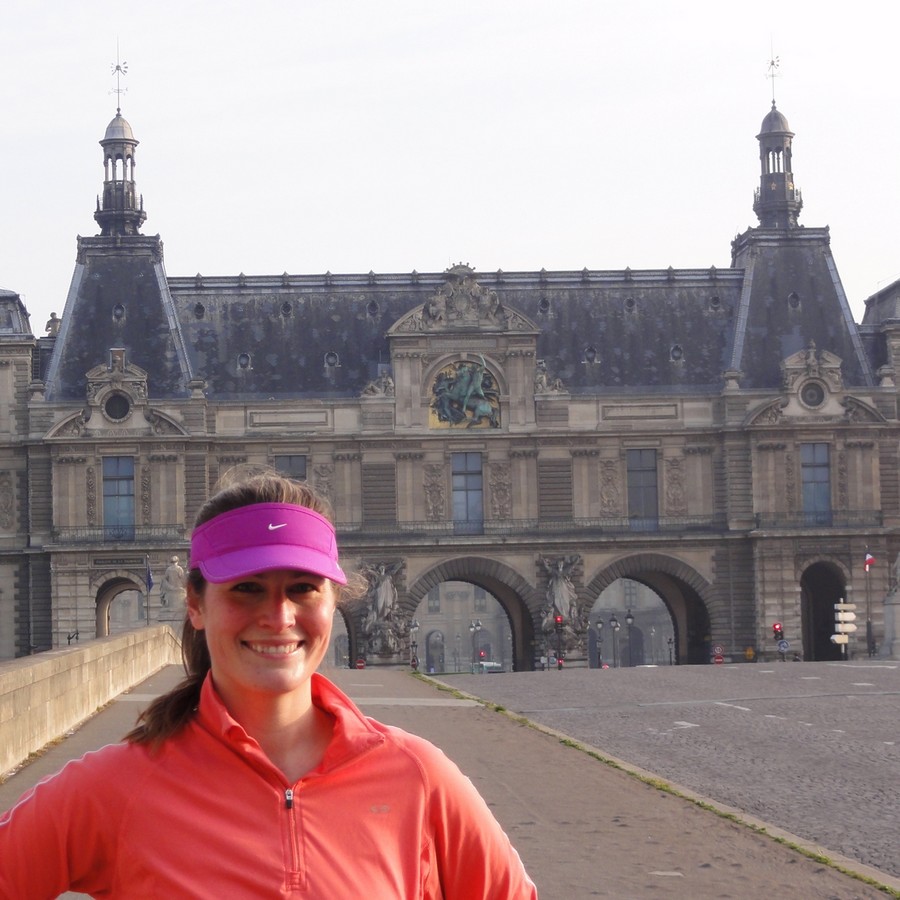
Kara – Bridge of the Carrousel 8:01 AM – With Kara, who comes from Atlanta (USA), we ran on an attractive route of more than 9 km and took advantage of the magnificent landscapes offered by Paris, emphasized by the sun which accompanied us this morning: splendid urban landscapes of Paris, buildings and monuments which revealed us small secrets during our running. For example on this photo of the Louvre taken since the bridge of the Carousel: do you see the lantern stands of the Pavilion of Lesdiguières which is at the right of the photo above? Let us look closer: Lantern of the Pavilion of Lesdiguières Golden “N” decorate the balcony of the lantern as on the one of the pavilion which faces it, the pavilion of Rohan. These “N” placed in the end of the Second Empire in the middle of the 19th century, honor the Emperor Napoleon III. But here, on the pavilion of Lesdiguières, these “N” are back to front! We think that the worker who put them, would have inverted them because of his hostility to Napoleon III! This small secret was discovered during the restoration of the Louvre museum in 1985, more than one hundred years after their installation! On the left, the lantern of the Pavilion of Rohan – On the right, the one of the Pavilion of Lesdiguières Not far from there, the famous Bridge of the Arts. Some tourists call it henceforth the “Love Padlocks” bridge*1… Kara – Footbridge of the Arts It is true that it is about one of the most romantic places of Paris, it would be only by its sight on the Island of the “Cité”. But what do we see if we get closer to the Island, behind the place Dauphine? A bird… A bird… It is one of the Imperial Eagles of the Justice Palace of Paris (Imperial Eagles dear to Napoléon the 1st, notice the “N” under the Eagle…): By pursuing our running in the Louvre, we decide to make a photo in the very beautiful squared courtyard (“Cour carrée du Louvre”): Kara – Cour carrée du Louvre Under our feet you can find the first Louvre, the Medieval Louvre, a fort protecting the West of Paris by strengthening the Outer wall of king Philippe Auguste. If you visit the basements of the Louvre, you can see the foundations of the medieval castle. Here is its representation and a photo of its foundations: Medieval Louvre – Foundations By leaving the Louvre, we go through the garden of Tuileries and its numerous statues: Kara – Garden of the Tuileries Notice for example, on the right-hand side of the photo above, the Statue of the Oath of Spartacus: By continuing along the historical axis of Paris, we arrive Place of La Concorde, magnificent place which really deserves a stop. Kara, “place de la Concorde” – In the axis, the Champs-Elysées with the “Arc de Triomphe” To the right, in the entrance of the Champs-Elysées, a rearing horse: one of the Horses of Marly. A copy of which the original is in the Louvre, original now protected from the vibrations provoked by the heavy machines of the National day military parade. Remember this article: Passing in front of the horses of Marly with Mary If we take a close look, we distinguish green flags. They are the flags of the Paris Marathon that took place five days earlier! Merci Kara ! The route of the tour: *1 The City hall of Paris recently decided to forbid the pose of these padlocks on buildings or bridges of Paris because they threaten and damage these Parisian heritage. Artists are requested to find a respectful replacement to these wild poses (Article France 3 – in French).
Medieval art, Art nouveau, Modern Art, 10 miles (16 km) in Paris with Lysa
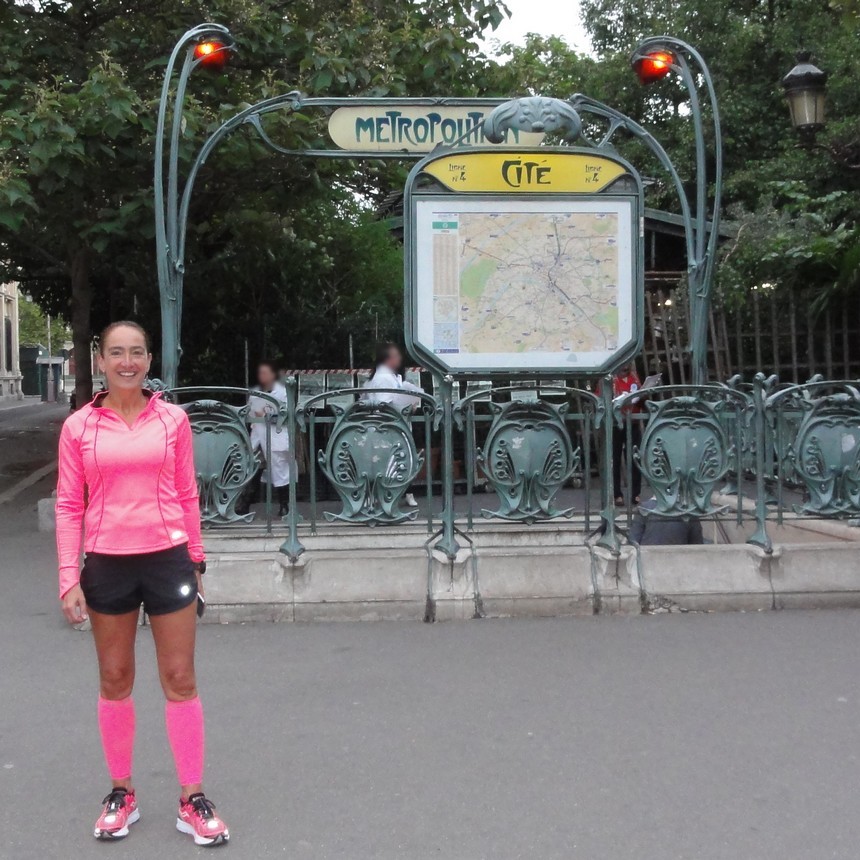
Lysa – Ile de la Cité (Island of the City) 7:03 AM – With Lysa, from Buffalo (New York), we made a 10 mile run (16 kilometers) to discover the numerous artistic facets of Paris. More than 2000 years of History… and artistic and architectural creations! Did you notice the numerous Parisian metro entrances with these arabesques forms, as the one that we see on the photo above next to Lysa? These entrances are typical artistic creations of the beginning of the 20th century, this art which we called the “Art Nouveau”. The creator, Hector Guimard, very representative artist of the “Art Nouveau” movement, realized 141 of these entrances of the Parisian subway from 1900 till 1912. Some entrance are even covered with a glass roof. Today, there are only 86 left, 2 with a glass roof as the “Porte Dauphine” one (West of Paris on the Avenue Foch): Hector Guimard’s subway entrances were offered to the subways of other cities as Montreal, Mexico City, Chicago, etc. There is even one in the Washington National Gallery of Art! Still on the Island of “La Cité”, we also admired two Medieval Art examples (vast ensemble of the Middle Ages Arts, covering a period of 1000 years): The famous Cathedral Notre-Dame-de-Paris, representative of the Gothic Art: Lysa and the Cathedral “Notre Dame de Paris” (on the left, the temporary installations celebrating 850 years of Notre-Dame) The Clock of the Conciergerie (for more information, read this article) : Lysa – Tour de l’Horloge (tower of the Clock) Further west, we met two forms of more recent arts: A plant wall! One of the first green walls realized by Patrick Blanc, who invented the concept of plant walls. This one was created in 2004, on one of the Quai Branly Museum administration building walls: Lysa – Vegetation wall (Patrick Blanc 2004) And of course, the famous Iron tower, the Eiffel Tower! The Tower was built for the World Fair of 1889. From 1889 to 1931, it was the highest monument in the world. During its construction, it was very criticized, but obtained a big success during the world fair of 1889, success which fell rather fast (in spite of a renewal of curiosity during the World Fair of 1900) We even intended to destroy it… It is now the most emblematic symbol of Paris! Lysa – Eiffel tower It’s a pleasure to run in Paris! Merci Lysa ! The route of the tour:
Postcards of an early morning running in Paris with Diana
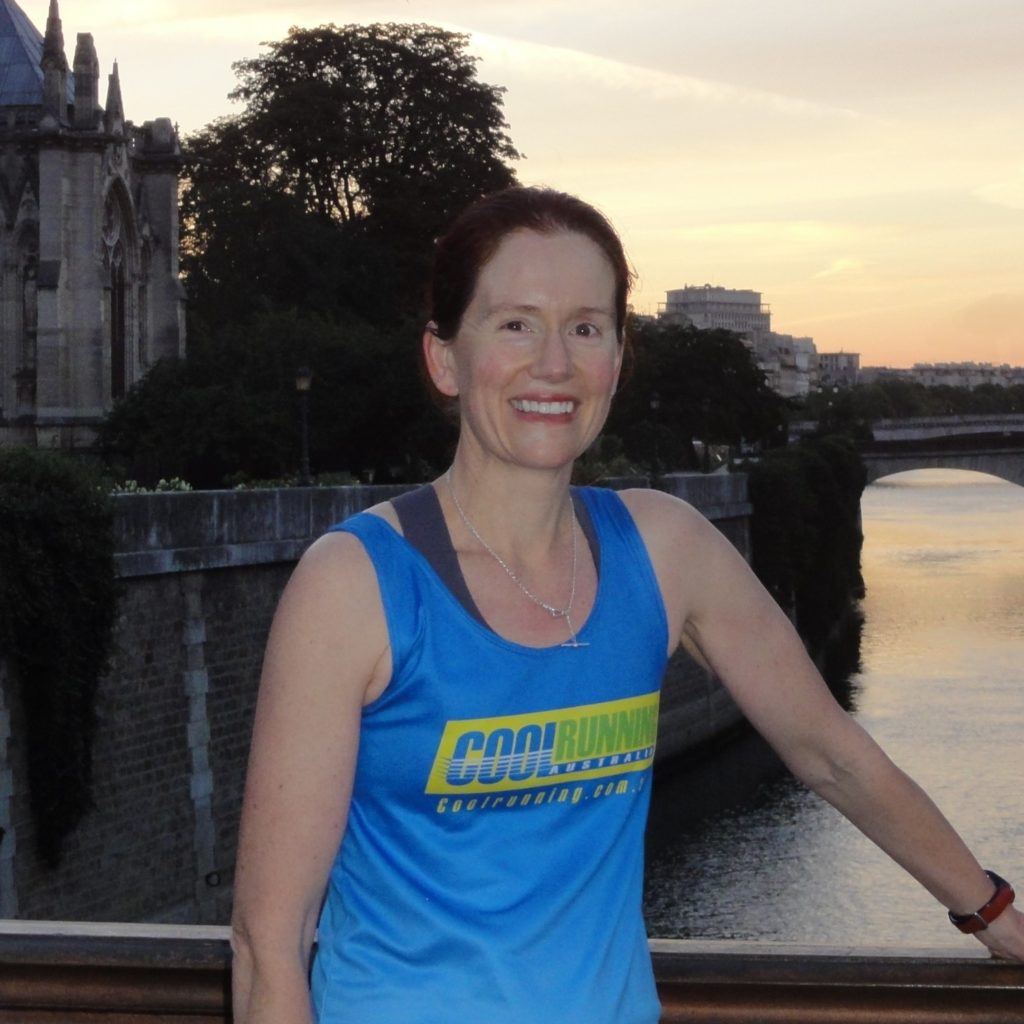
6:35 AM – Diana, Australian runner, came to settle down with her family for some time in France. What better way to begin the visit of Paris than a very early morning run? Here are some postcards of our cultural and sports visit: We enjoyed very much running on the “Pont des Arts” (Bridge of the Arts): Merci Diana ! The route of the tour:
A magnificent dawn in Paris with Marnie
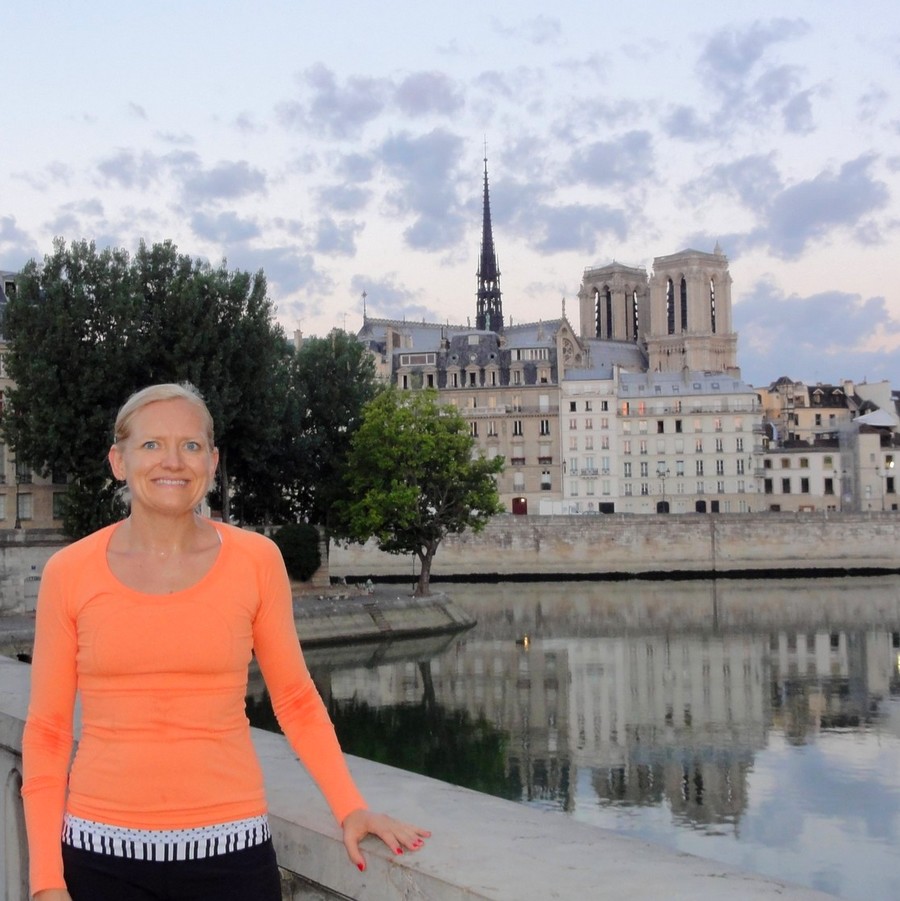
Marnie – “Pont Louis-Philippe”, on the left, “Ile St-Louis”, in the background, “Ile de La Cité” and Notre-Dame 5:52 AM – Marnie lives in Singapore. After having run several half marathons, Marnie prepares a marathon she will run this autumn. How to prepare a marathon while visiting Paris? A long tour with Paris Running Tour! Ideal to discover the city while doing our training. We thus traveled on a circuit of more than 18 km kilometers, with an amazing Parisian landscape parading under our eyes. We discovered a totally deserted Paris, embellished by the magnificent light of the rising sun. Deserted Paris? A start before 6 am + on Sunday + August! The Parisians went on holiday, tourists still sleeping, well parked cars. Paris only for us! Look on how the “Place de la Concorde” is deserted and beautiful in all the splendor of this summer morning: Marnie – “Place de la Concorde” Nobody in front of the “Palais de Justice” either… The Sainte Chapelle and Conciergerie, which surround it, are still in the quiet before the arrival of the visitors during the day. Marnie – The “Palais de Justice” of Paris, on the left, the “Sainte Chapelle”, on the right, the “Conciergerie” We ran along the river Seine which we crossed several times to benefit from beautiful points of view on Paris: Marnie – “Pont Neuf”, in the background, the “pont des Arts” Marnie – Footbridge Senghor, on the left, the Louvre, on the right the “Musée d’Orsay”, in the background, Notre Dame On the new banks of Paris, we made a little sprint to test the new new athletic track of one hundred meters: Marnie – New banks of Paris, athletic track of 100 meters Souvenir photo on the Esplanade of the Trocadéro, the best point of view to see the Eiffel Tower: Paris Running Tour – Marnie – The Eiffel tower – On the left, the dome of the Invalides Merci Marnie ! The route of the tour:
Around the Louvre with Janaina and Gustavo
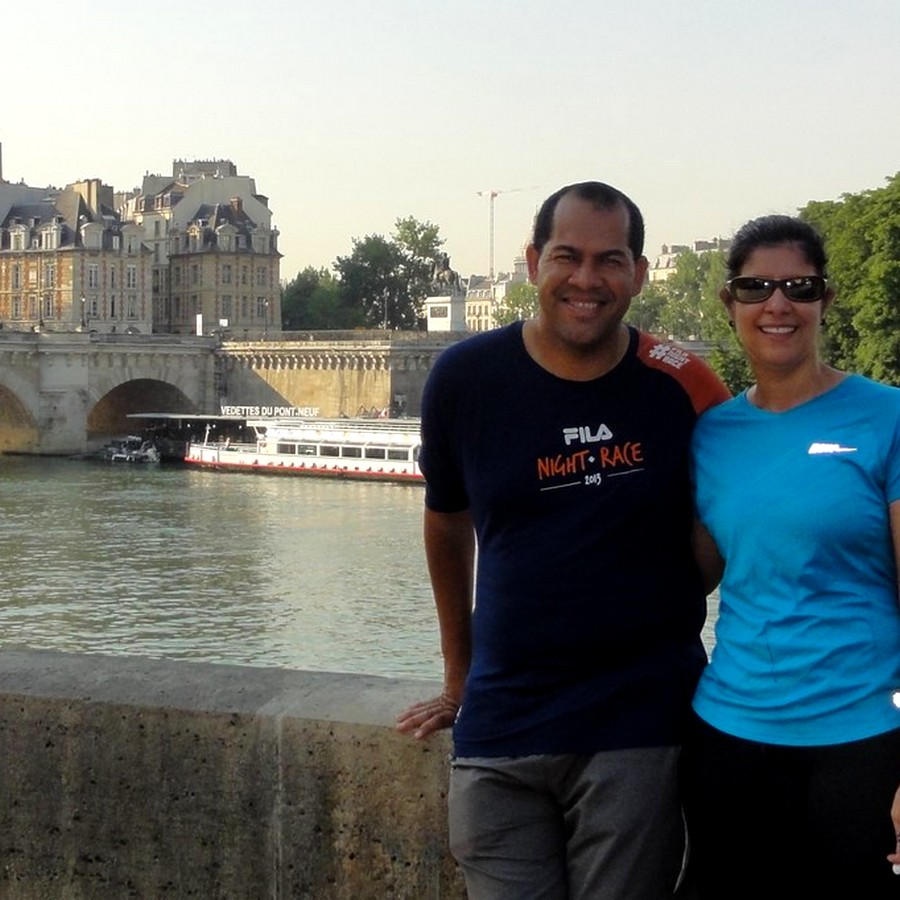
7:13 AM – Gustavo and Janaina live in Salvador (Brazil). To visit Paris by running, we chose a beautiful stroll around the Louvre. We left the Grands Boulevards and went through the “passage des Panoramas” (see the previous post), the “Palais Royal”, and then we joined the Louvre, by crossing the Street of Rivoli: The Passage Richelieu connects the street of Rivoli with the Louvre Pyramid and allows to see the beautiful sculptures of the Puget and Marly courtyards (remember the article which speaks about the horses of Marly) : After this small break in front of the passage Richelieu windows, we continued our running at the foot of the Pyramid, the magnificent glass pyramid which respects the central space of the Louvre and allows to see the Louvre in its totality: What was there before the Pyramid? A stand of trees where cars could park. At the foot of the trees, impossible to see all the facades: In the same direction, towards the garden of the Tuileries, we had a photo break to take advantage of the view on the Eiffel Tower, the “Musée d’Orsay” and also some statues of Maillol. Look for them in the bushes by enlarging the photo: We then left the garden of the Tuileries by way of the small tunnel which goes out of the garden by going towards the river Seine. We crossed the Seine by the footbridge Léopold Sédar Senghor and going up the staircases of the bridge, where we enjoyed a beautiful point of view on Notre-Dame: On the other side of the bridge, we saw the beautiful Palace of the Legion of Honor, cleaned recently (we had spoken about its replica in San Francisco here): Evoking the various places to run, we spoke about the immense and long beautiful beaches of Brazil. In Paris, we also have the opportunity to have some beaches 😉 At least from mid-July to mid-August, the banks of the “Right bank”, in particular, welcome the operation “Paris-Plages“: A little farther, near the Louvre, is the Louvre Oratory, with the Statue of the “Amiral de Coligny”, whose tragic end reminds us sad moments of the French History: On our road, we passed by the beautiful “Véro Dodat” gallery and we were amazed by the height of a famous Parisian shoemaker’s shoes (see below, near the passage, the Christian Louboutin’s first shop): Merci Janaina, merci Gustavo ! The route of the tour:
In front of the oldest tree of Paris with Michael
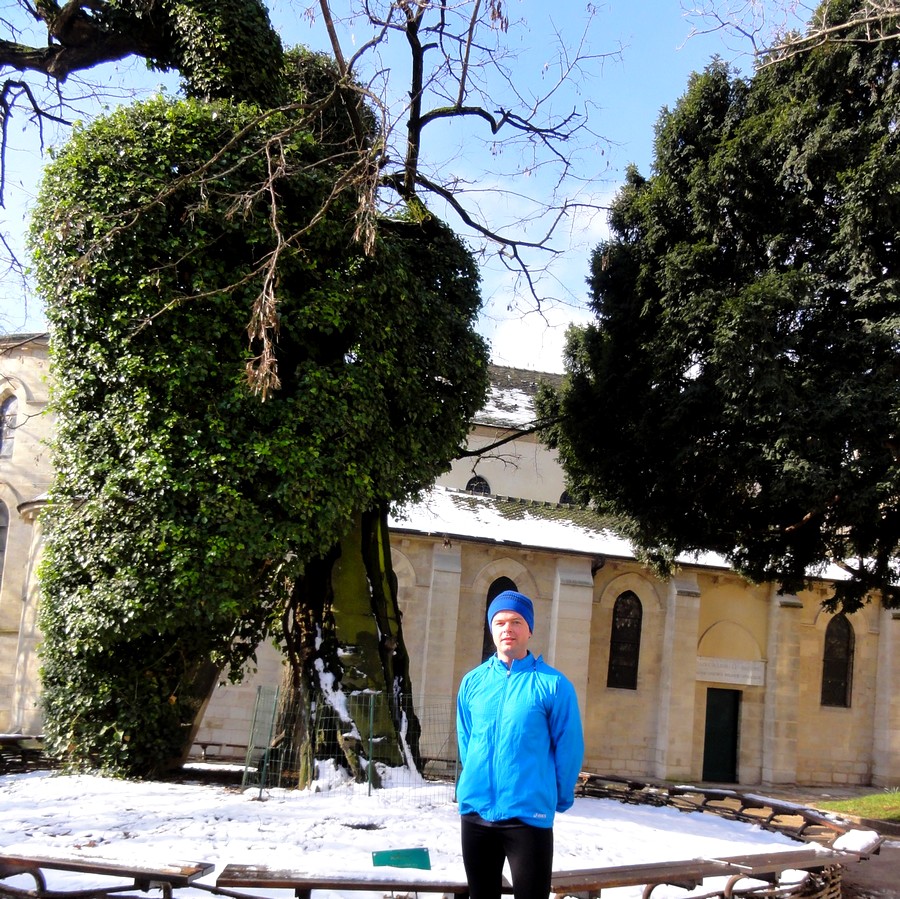
Michael – Garden René Viviani, in the background the church “Saint-Julien le Pauvre” 9:01 AM – Michael, who lives in Hamburg (Germany), began his first visit of the capital by a Paris Running Tour. Having left the district of the “Gare de Lyon”, we traveled the garden of Plants, crossed the Latin Quarter on the left bank, visited the Island of “La Cité”, then of return on the right bank, saw the Pompidou Center and the “Marais” quarter. We discovered in particular the Gallo-Roman Paris by admiring the Arenas of Lutecia, the Roman Thermal baths and the archaeological crypt where we can see real Roman streets. Before leaving the Latin Quarter, in the Public garden René Viviani, we greeted the oldest tree of Paris (we can see it on the photo above). This Black Locust tree (Robinia pseudoacacia) was planted in 1601 by the botanist Jean Robin who introduced it in France (the tree is native of North America). The public garden René Viviani faces the Cathedral Notre-Dame-de-Paris as we can see on the photo below: Michael – “Square René Viviani” and Notre-Dame de Paris A little earlier, it is another place of worship we crossed, the Big Mosque of Paris: The “Grande Mosquée” of Paris The Big Mosque of Paris was inaugurated in 1926. Of Spanish-Moresque style, it possesses a 33 meter minaret. The Mosque is opened to the tourist visits. On the right bank, very close to another “temple”, “temple” of the culture this time, the Georges Pompidou Contemporary Arts Center, we contemplated beautiful mural paintings, of which the stencil “Chuuuttt!!!” of Jef Aérosol: Michael – “Chuuuttt !!!” from Jef Aérosol (2011) In the “Marais”, we took a shortcut which made us, directly from the street Saint Antoine pass on the beautiful “Place des Vosges”: Michael – “Hôtel de Sully” A magnificent shortcut, the Hotel of Sully! This “Hôtel particulier” (mansion) allows to join the “place des Vosges” by way of the inside courtyard and the garden. Built at the beginning of the 17th century, it was the property of the “Duke de Sully”, king Henri IV’s Minister of Finance. It shelters now the Center of the National Monuments. Merci Michael ! The route of the tour :