
A little bit of Paris in one minute #7 In Paris, the oldest…
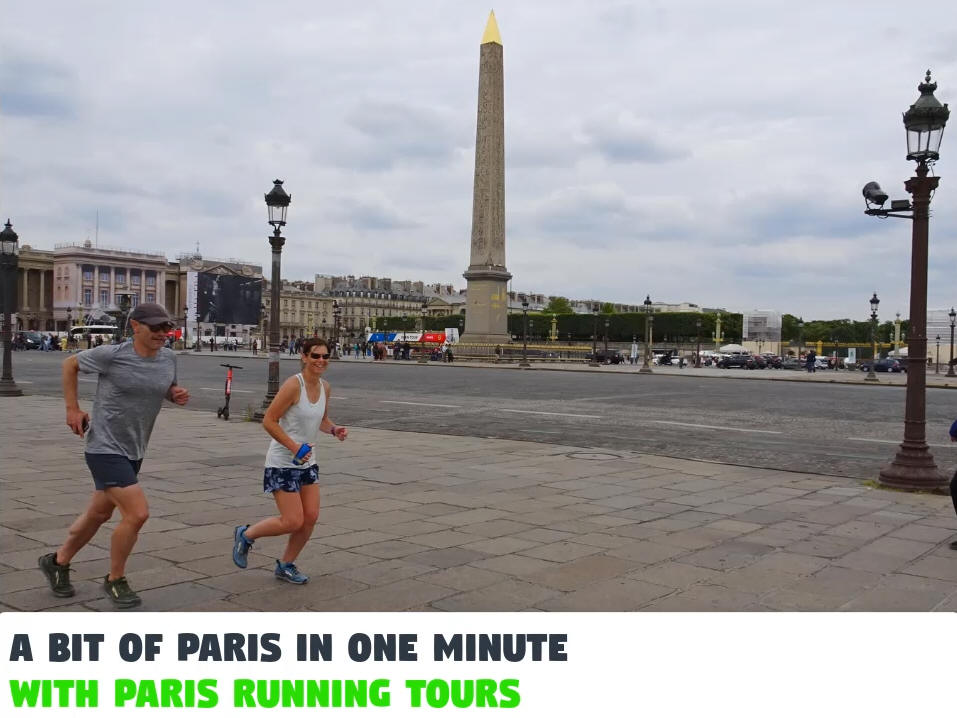
A little bit of Paris in one minute #7 In Paris, the oldest… …monument: Luxor Obelisk, ~3310 years old, …street: rue Saint Jacques (former Roman Via superior), ~2050 years old, …stadium: Arènes de Lutèce, ~2000 years old, …church: église Saint Germain des Près, ~1460 years old, …house: maison de Nicolas Flamel, 613 years old, …tree: a locust near Notre Dame, 418 years old, …bridge: Pont Neuf (the new bridge!), 413 years old, …square: Place des Vosges, 408 years old, …”Café”: Le Procope, 334 years old, …Theatre: Theatre de l’Odéon, 238 years old, …covered passage: Le passage des Panoramas, 221 years old, …running tour guide in Paris: 10 years old! 😃 10 years enjoying being your guide in Paris, Thanks to all the visitors who come to enjoy Paris with us! If you too, you come to Paris, we will be very happy to run with you. Join us and discover Paris with authentic Parisians guides who will take you on the best sight running routes in Paris and who always have tons of secrets to share with you: Music: Vlad Gluschenko — Harmony License: CC BY 3.0: https://creativecommons.org/licenses/by/3.0/deed.en
A new Running Tour in Paris with Cori
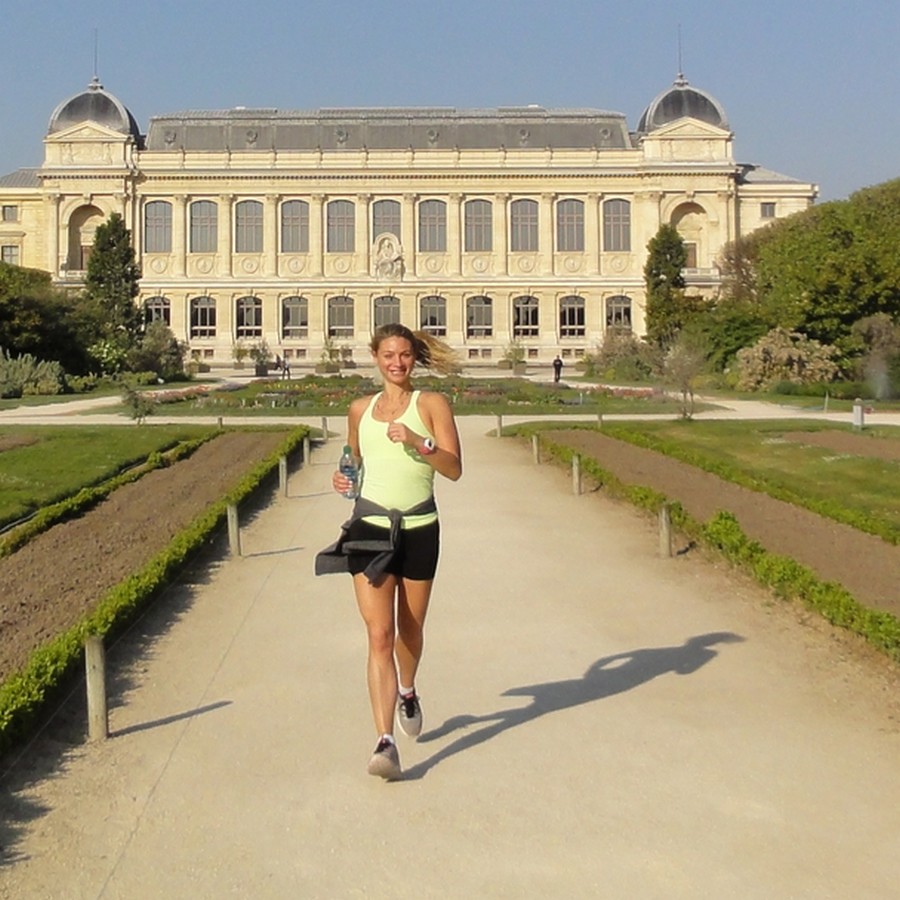
8:05 AM – Do you remember Cori? We ran together in April 2012. It rained that time, which had not prevented us from making an attractive run in Paris. In this month of April 2015, the weather is beautiful and we can enjoy the sun. Although we pass again by the “Pont des Arts” (Bridge of Arts), we choose a very different route. Compare both views of the “Pont des Arts” in April, 2012 and April, 2015: Cori – “Pont des Arts” – April 2012 and April 2015 Look at the sides of the “Pont des Arts”. We have already spoken a lot about the famous Padlocks of Love. In 2012, they are already present and begin to be many but not still in the point to make bend and fall the railings which carry them. In 2015, the railings fell and were replaced many times: the padlocks placed on the railings, themselves covered by other padlocks, finished to be too heavy. Paris decided to act: at first, the padlocks will be replaced in May by panels painted by artists then, in September, by transparent Plexiglas panels. Now, this April, it is temporary wooden panels which line the bridge (graffitis did not delay covering them). For our new circuit in Paris, we favored parks and gardens. What a pleasure to run under the sun there. We discover: The “Jardin du Luxembourg” and its magnificent “Fontaine Medicis” (Medici Fountain) Cori – “La Fontaine Medicis” “Les Arènes de Lutèce” (Arenas of Lutetia), with soccer players, gladiators having left for quite a long time 🙂 Cori – “Les Arènes de Lutèce” “La Grande Serre du Jardin des Plantes” (the Great Greenhouse of the Garden of the Plantes) (go there, a real jungle in Paris!): Cori – “La grande serre du Jardin des Plantes” Merci Cori ! The route of the tour:
14 miles visiting Paris while running to prepare the New-York marathon, with Jess
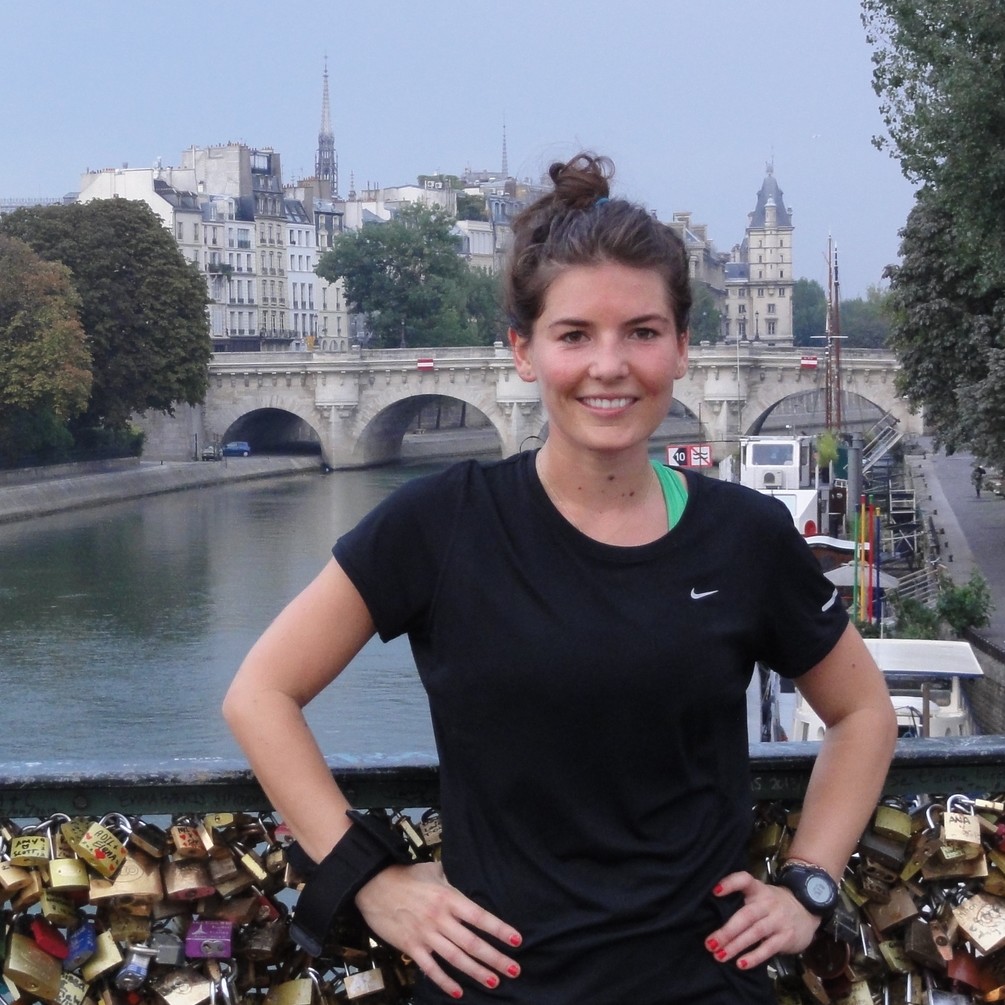
Jess – “Pont des Arts” (Bridge of the Arts) and view on the Island of the City (“île de la Cité”) 7h11 – Jess, marathon runner of New York (USA), in business trip in Paris, had two objectives by making a running tour: discover Paris and make a long run to prepare the New York marathon. We thus made a running of 14 miles (23 km) in Paris, distance which allows a beautiful visit of the city and the discovery of its numerous aspects. At first, a short pause to remember the objective, 26.2 miles (42.195 km) in New York: Jess – Avenue de New-York Then, from the avenue of New York, a small ascent (light preparation of the hilly New York marathon route) to join the Esplanade of the Trocadéro, the most beautiful view on the Eiffel Tower: Jess – “Esplanade du Trocadéro” We then leave the Eiffel Tower by the “Champ de Mars”: Jess – “Champ de Mars” Formerly used for military maneuvers, the Champ de Mars is now an ideal training ground for the runners: firm and supple hard-packed surface, buckle of 2 km, garden always opened (without railings), enlightened paths… Perfect circuit for the early morning runners! Much more east of Paris, it is on the sandy soil of the Lutetia arenas that we ran: Jess – “Arènes de Lutèce” Nowadays, we meet “pétanque” players or amateur soccer players there… About 2 000 years ago, there, we could see gladiators fighting, wild animals and also theater plays. Paris, at the time, was Roman and was called Lutetia. Of course, we did not miss numerous majors places of Paris, for example, the “Pont des Arts” (as we can see in the first photo of this article with its beautiful view on the Island of the City) or the Louvre Pyramid: Jess – The Louvre pyramid Since this sports stroll in Paris, Jess ran the marathon of New York with a beautiful performance. Paris Running Tour hopes to have contributed to this a little… 😉 Merci Jess ! The route of the tour :
Historic, artistic, scientific and sports stroll in Paris with Isabel
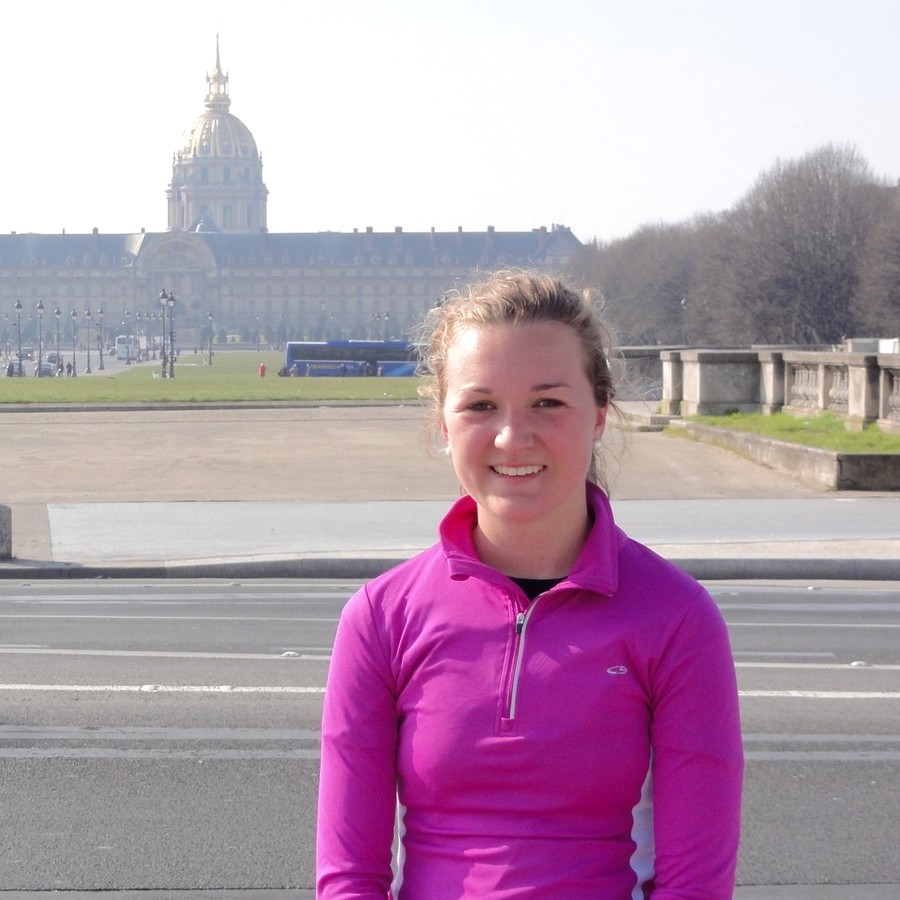
Isabel – Les Invalides 8:59 – Isabel, from Baltimore (USA), is a young, very regular runner as she runs 6 days a week. Visiting Paris, why not discovering the city by running? We thus went for 17 kilometers with a good pace for a stroll which we can qualify as historical, artistic, scientific and of course, sporting. Historical: Every Parisian place is a witness of the History, whether it is a small street, a small garden either a famous place or a most known building, for example, the “Invalides”. The “Invalides” reminds the will of king Louis XIV to regroup the disabled war veterans in a dedicated place, the “Hôtel des Invalides“. We can see the magnificent building in the background of the photo above. The dome is covered with 12 kilograms of gold deposited in fine layers. Inside, thrones the grave where rest Napoleon. A little earlier, we crossed the “Arènes de Lutèce” (see the picture above). At the time of the Roman Empire, more than 15000 spectators saw there the gladiators fought and wildcats appeared. They also could applauded theater performances. These arenas, rediscovered in the 19th century, have now more modest dimensions, but we can always see games there, more quiet certainly, as football (soccer) or “pétanque” (a form of lawn bowling). Lutecia was the former name of Paris in this period. Isabel – The Arènes of Lutèce Scientific : If there is a garden dedicated to the sciences, the “Jardin des plantes” is the one indeed: Isabel – Garden of the plants/Natural history museum – In the background, the great Gallery of the Evolution The garden of plants is, first of all, a botanical garden. It is a magnificent park which contains at the same time very big Greenhouses and specialized gardens, for example, the Alpine garden. The buildings contain various galleries dedicated, among others, to the mineralogy and to the geology, to the evolution, and to the paleontology. We see the gallery of the paleontology on the photo below (see, behind the windows, the big skeleton of a whale): Isabel – Gallery of Paleontology The garden of plants also contains a menagerie, one of the first menageries of the world. Even if these mammals do not exist any more, we were able to cross a mammoth on our way! The Mammoth of the “Jardin des plantes” – By his side, Isabel Artistic: Paris is a city of Art which counts at least 130 museums. Among them, the Museum of Modern Art: Isabel – Paris Modern Art Museum The Museum of Modern Art presents numerous works of the 20th century, some are famous (Picasso, Matisse, Braque, Modigliani, …) Finally, even though if it was rejected by numerous artists during its creation, is not the Eiffel Tower a gigantic work of art? Isabel – The Eiffel tower from the “Palais de Chaillot” Merci Isabel ! The route of the tour:
In front of the oldest tree of Paris with Michael
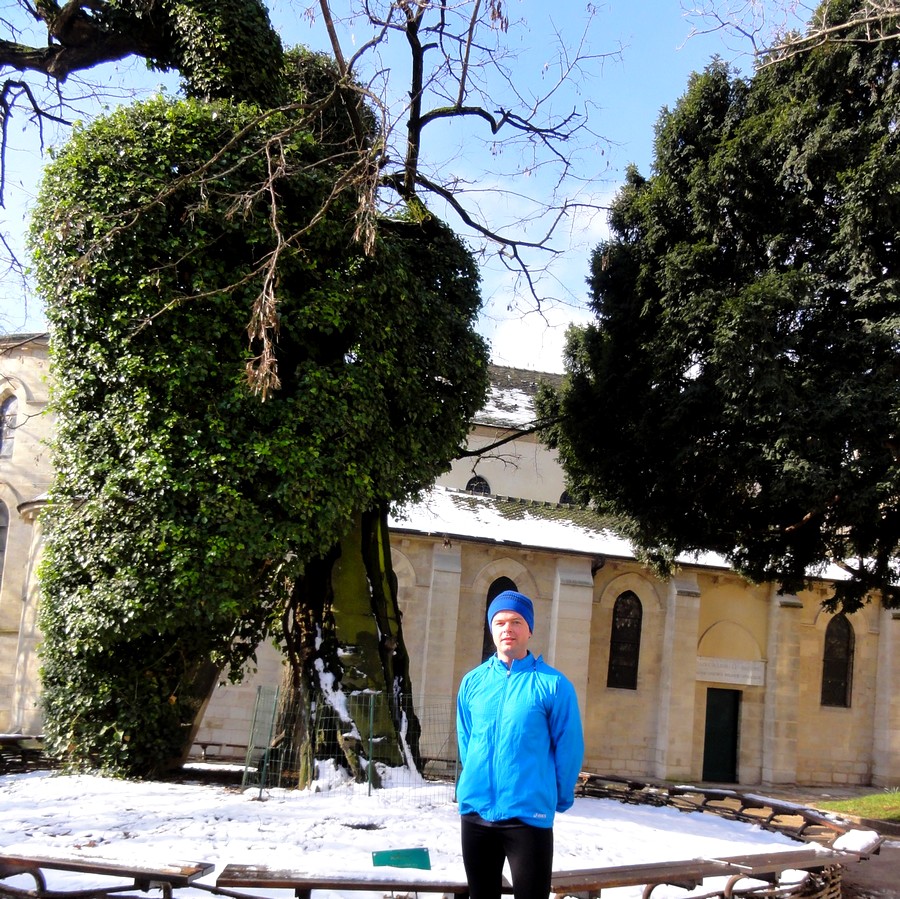
Michael – Garden René Viviani, in the background the church “Saint-Julien le Pauvre” 9:01 AM – Michael, who lives in Hamburg (Germany), began his first visit of the capital by a Paris Running Tour. Having left the district of the “Gare de Lyon”, we traveled the garden of Plants, crossed the Latin Quarter on the left bank, visited the Island of “La Cité”, then of return on the right bank, saw the Pompidou Center and the “Marais” quarter. We discovered in particular the Gallo-Roman Paris by admiring the Arenas of Lutecia, the Roman Thermal baths and the archaeological crypt where we can see real Roman streets. Before leaving the Latin Quarter, in the Public garden René Viviani, we greeted the oldest tree of Paris (we can see it on the photo above). This Black Locust tree (Robinia pseudoacacia) was planted in 1601 by the botanist Jean Robin who introduced it in France (the tree is native of North America). The public garden René Viviani faces the Cathedral Notre-Dame-de-Paris as we can see on the photo below: Michael – “Square René Viviani” and Notre-Dame de Paris A little earlier, it is another place of worship we crossed, the Big Mosque of Paris: The “Grande Mosquée” of Paris The Big Mosque of Paris was inaugurated in 1926. Of Spanish-Moresque style, it possesses a 33 meter minaret. The Mosque is opened to the tourist visits. On the right bank, very close to another “temple”, “temple” of the culture this time, the Georges Pompidou Contemporary Arts Center, we contemplated beautiful mural paintings, of which the stencil “Chuuuttt!!!” of Jef Aérosol: Michael – “Chuuuttt !!!” from Jef Aérosol (2011) In the “Marais”, we took a shortcut which made us, directly from the street Saint Antoine pass on the beautiful “Place des Vosges”: Michael – “Hôtel de Sully” A magnificent shortcut, the Hotel of Sully! This “Hôtel particulier” (mansion) allows to join the “place des Vosges” by way of the inside courtyard and the garden. Built at the beginning of the 17th century, it was the property of the “Duke de Sully”, king Henri IV’s Minister of Finance. It shelters now the Center of the National Monuments. Merci Michael ! The route of the tour :
Four mornings to explore Paris with Sarah
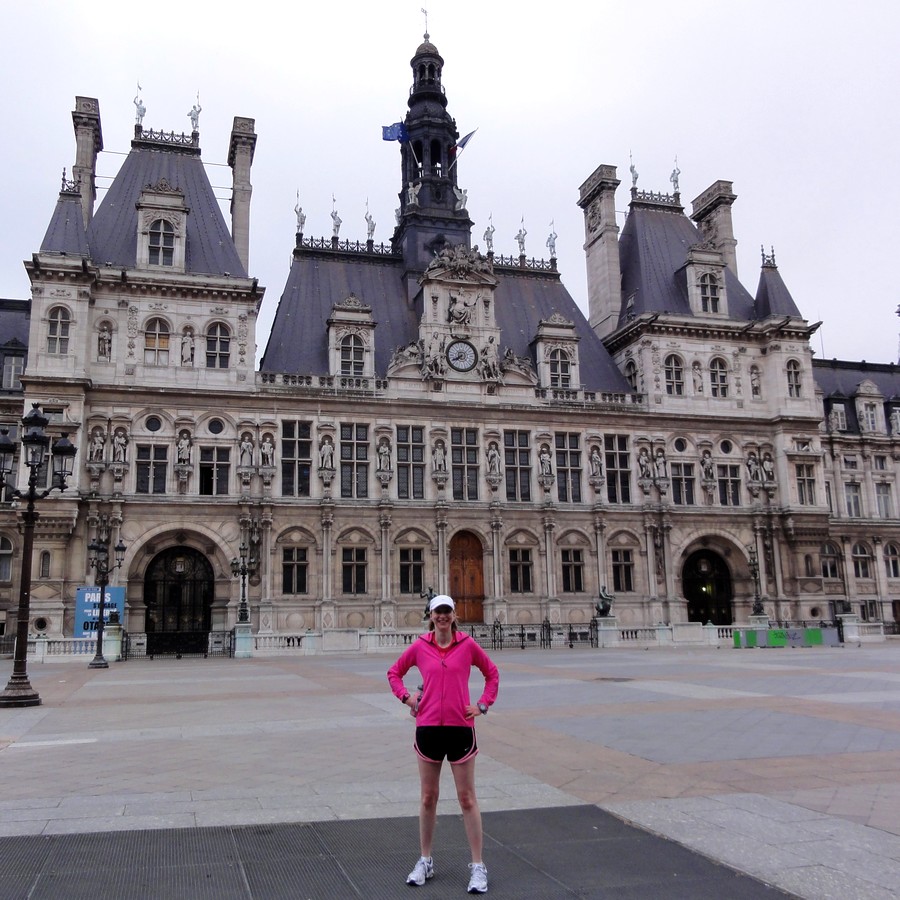
Sarah – Hôtel de Ville 6:30 AM – Sarah of Houston (USA), wished to discover Paris by running four following mornings with Paris Running Tour. It is thus with a big enthusiasm that we investigated the center of Paris as well right bank as left bank (see routes at the end of the post). Did you know that the metric system was set up during the Revolution? The National Convention (constitutional and legislative revolutionary assembly), to generalize the use of the metric system disposed sixteen marble standard meters at the most frequented places of Paris. These meters were installed between February, 1796 and December, 1797. With Sarah, during our explorations, we found both last ones which remain at present in Paris, the one of the right photo being the only one still on its original site: Standard meter Place Vendôme – Standard meter street of Vaugirard On the “grands boulevards”, we discovered two triumphal arches: Porte Saint-Martin – Porte Saint-Denis Yes, before the Arcs of Triumph wanted by Napoleon the 1st, place de l’Etoile and in the Carrousel of the Louvre, Louis XIV ordered the construction of these two Arcs in honor of his military victories (See the inscription at the top of the Arcs: “Ludovico Magno”, Louis the Great). Louis XIV, Sun King did not only make Versailles! The Arc of “La Porte Saint Denis” (“Porte”=door) and the Arc of “La Porte Saint-Martin” are in the location of former fortified doors of Paris, both belonging to the surrounding wall of king Charles V. Indeed, the “Grand boulevards” which we know now correspond to the ancient surrounding fortifications of Paris, built by Charles V, widened by Louis XIII, then destroyed under Louis XIV The word “Boulevard” comes moreover from the word “Bolevers” which comes itself from the ancient Dutch word “Bolewerk” meaning “Ramparts”. From the Charles V’s surrounding wall (1383) to the “nouveau Cours” (1705 ) – Representation of the door Saint-Martin See these trees planted all along the Boulevard. The Parisians called them “boules vertes” (Green balls). Boules vertes = Boulevards! Other origin of the word! Among our other historic explorations, we found the ancient Arenas of Lutetia (Lutetia = Paris before the third century later JC). They were accidentally discovered by chance during works in 1870. These Roman arenas could contain more than 10000 spectators. Under their eyes took place gladiators’ fights, fights of wildcats but also representations of comedies or dramas. Sarah – Arenas of Lutetia Nowadays, it is a quiet place for games of balls or tournaments of petanque. From time to time, theater companies play there. Merci Sarah ! The routes of the four tours: